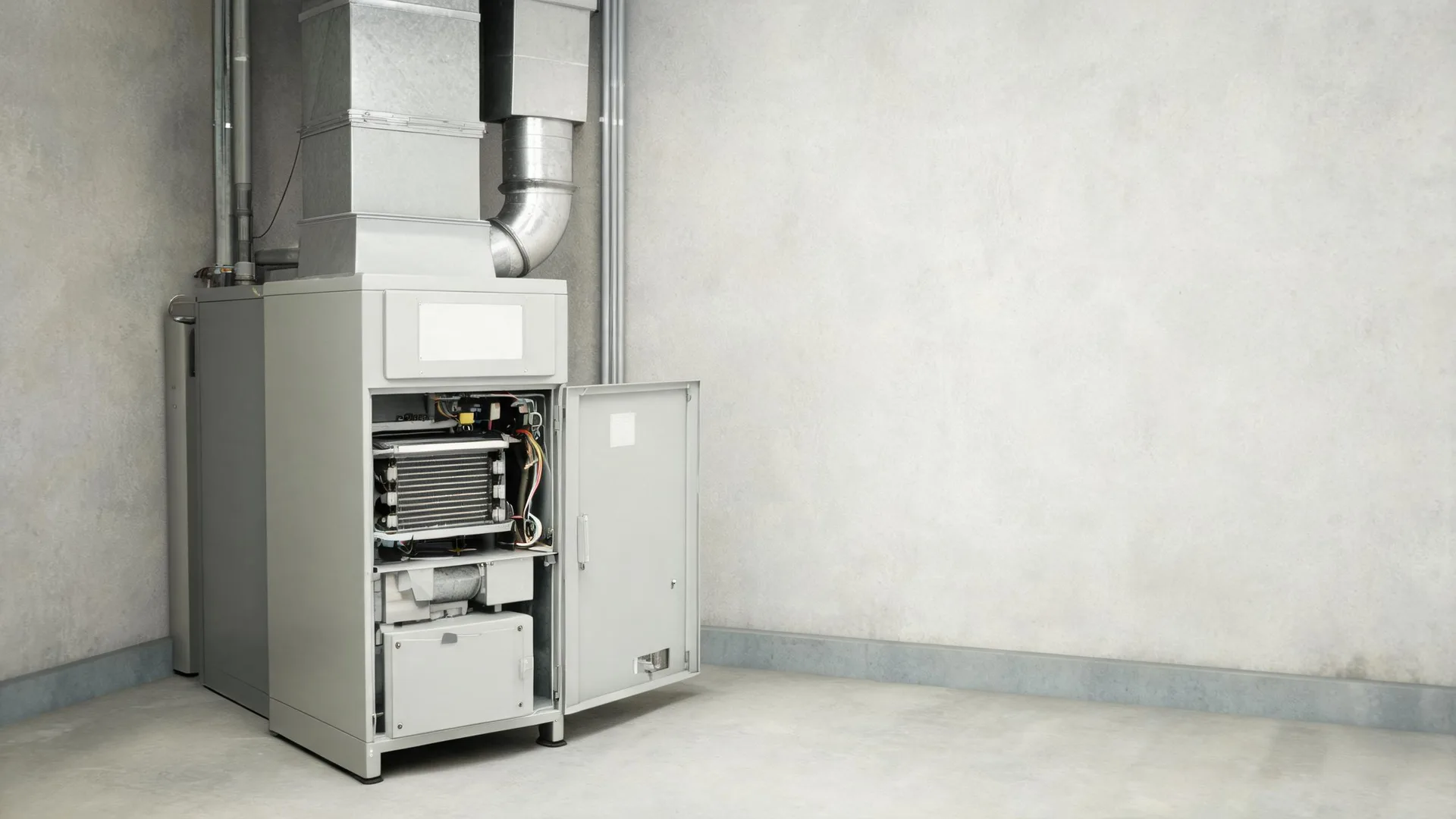
September is the month to get it looked at
Furnaces here sit unused since spring, and October is when they go back to work. A weak igniter or a failing inducer motor often won't show itself until that first real call for heat.
Takes about a minute. No obligation.
Furnaces here sit unused since spring, and October is when they go back to work. A weak igniter or a failing inducer motor often won't show itself until that first real call for heat.
Heat runs here from October through April, about seven months straight. Whatever was already marginal in your furnace tends to give out early in that stretch, not in the middle of it.

NOAA nClimDiv, 1991–2020 normals
A cracked heat exchanger gets worse every hour the furnace keeps firing on it.
Shut it down and get it looked at before that next call for heat, not after.




If your house was built in 1955 or earlier, there's no telling from that alone how old the furnace actually is. It may have been swapped out years ago, or it may be the original. Before paying for a major repair, ask the tech to tell you straight how much life is left in the unit. That answer should come before the estimate, not after you've already paid for the part.
Problems tend to show up in the first weeks of the season, when the load hits a part that was already weak.
Find a contractor
A furnace that short cycles, turning on and off every few minutes instead of running a full heating cycle, has a problem somewhere in the system. So does one that runs long stretches without getting the house to temperature. Listen for a burner that clicks and won't catch, or catches and then shuts back off. That's usually the igniter or the flame sensor losing the fight, and it tends to get worse call by call rather than fixing itself. A blower that keeps running after the house is warm, or air coming out lukewarm instead of hot, points to a different problem but it's worth the same call. Rattling, banging on startup, or a burning smell that doesn't clear after a few minutes are not things to wait out.
Every cycle heats it up and lets it cool back down, and that cycling is what eventually cracks it or wears it thin. It's one of the most replaced parts in any furnace for that reason, not because of anything done wrong.
The sensor builds up a film after enough burn cycles and stops recognizing the flame is lit, so the furnace shuts the gas back off as a safety measure. It looks like a failure but it's often just buildup, and that's a different fix than swapping the part.
Estimates for a typical Bronx County home, compared with an older unit built to the previous federal minimum, from EIA household energy data, New York fuel prices and NOAA climate normals. Your home will differ.
Repair makes sense when one part has failed and the heat exchanger is sound.
Replacement makes sense when the heat exchanger is cracked or the furnace keeps needing parts.
A diagnostic visit starts before any panel comes off, with the tech asking what the furnace is doing and when. Short cycling, a burner that won't catch, lukewarm air, all of that narrows things down before a single tool comes out. Next comes a look at the flame itself, its color and shape, since a flame that's yellow or uneven points toward a combustion problem rather than an electrical one. The tech will pull the igniter and flame sensor to check them directly rather than guess from the symptoms alone. Airflow gets checked too, because a filter clogged enough or a blocked vent can mimic problems that have nothing to do with the furnace itself. Only after all that does the tech say what's actually wrong and what it takes to fix it.