Gas here runs $16.03 per million Btu
New York homes paid $16.03 per million Btu of natural gas in 2024. A furnace running on hard Ithaca winters burns through that at a real rate, not an occasional one.
Takes about a minute. No obligation.
New York homes paid $16.03 per million Btu of natural gas in 2024. A furnace running on hard Ithaca winters burns through that at a real rate, not an occasional one.
Two furnaces can carry different running costs for as long as the system is in the house. In a place where the gas rate itself is high, the furnace's efficiency rating matters more to what it costs to own.
NOAA nClimDiv, 1991–2020 normals
Furnaces here start running in September.
Installing one in August means it's ready before the first cold night, not scrambled together after it.




Tompkins County falls under zone 5A in the 2021 energy code, a cool zone where the heating load carries more weight than cooling. That classification sets a floor under what can be installed here. Any indoor gas furnace made from November 2015 onward has to turn at least 80 percent of the gas it burns into heat over the winter. That's already the baseline for anything going into a home here now. Starting in December 2028, new units will need to hit 95 percent, so the standard is only moving in one direction.
The furnace going in now will carry that $16.03 rate for as long as it's in the house. Picking it on the efficiency rating, not just the upfront price, is what decides whether this winter's gas bill and next year's are lower than they had to be.
Find a contractor
Nine months of runtime a year means this furnace needs to be sized for the house it's going into, not picked off a list by price. A unit too big cycles on and off all winter and wears at the parts that start it up. One too small runs flat out on the coldest nights and still falls short. Either way, the load calculation a contractor runs before install matters more here than it would somewhere the furnace only works a few months a year.
AFUE tells you how much of the fuel burned actually turns into heat in the house, averaged over a full year of starts, stops and weather. The rest goes out the flue. A furnace with a higher AFUE wastes less gas doing the same job of warming the house. It's a rating of the machine, not a promise about any one month's bill, since how much it runs still depends on the house around it.
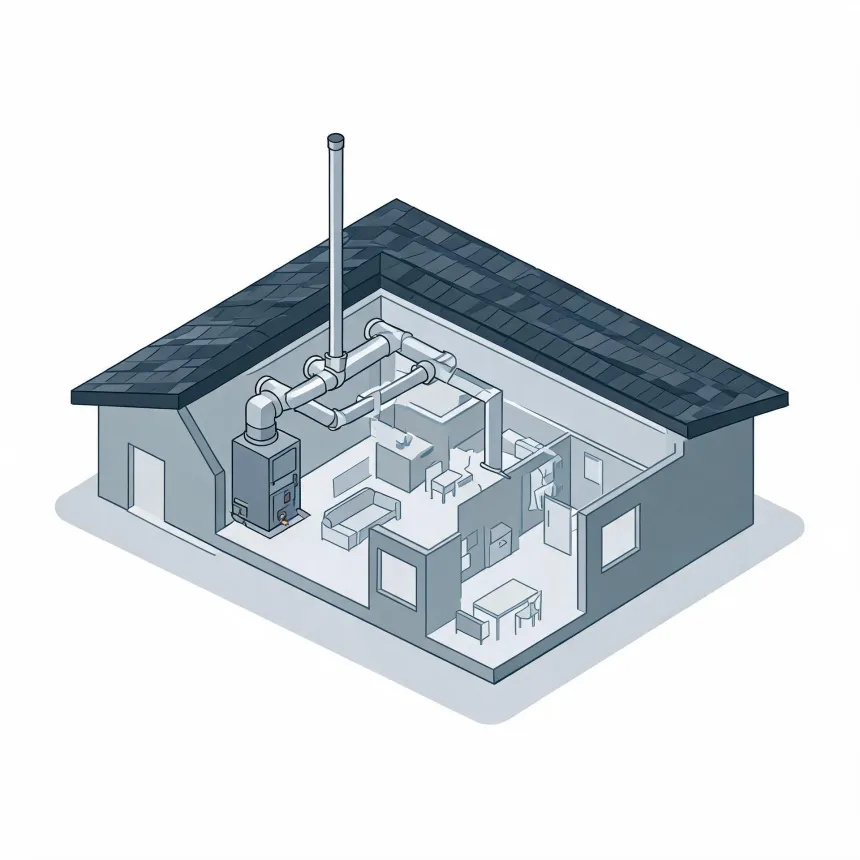
A low-efficiency furnace vents through a metal flue and keeps its exhaust hot enough to rise on its own. A high-efficiency furnace cools that exhaust first and vents it out through PVC pipe instead, usually with a drain for the condensation that forms. That's a different venting path through the house, not just a different burner. Knowing which type is going in changes what the installer has to run and where, before the furnace itself ever gets picked.
Estimates for a typical Tompkins County home, from EIA household energy data, New York fuel prices and NOAA climate normals. Your home will differ.
A furnace swap is usually a one day job, start to finish. The old unit gets disconnected from the gas line, the duct trunk and the flue, then it comes out. The new one gets set, leveled, and connected to the same three things, plus a power circuit for the blower and control board. If it's a high-efficiency model, there's also a condensate drain to run and PVC venting to install, which takes longer than hooking up a metal flue. Once it's in, the contractor fires it up, checks the gas pressure, and measures the temperature rise across the heat exchanger to confirm it's burning right. The last step is combustion testing, making sure the exhaust is venting clean before anyone signs off on the job.