






Why your gas furnace won't light in Rochester, NY

RepairFurnace or heatingMonroe County, NY
Step 1 of 2

What ZIP code is the job in?

A gas furnace that won't light usually comes down to one of a few things. The igniter can burn out, which is the most common reason after a furnace has run for a few winters. The flame sensor can get coated with soot and stop sensing a flame that's actually there, so the furnace shuts itself down as a safety measure. A clogged filter can choke off airflow until the furnace overheats and trips its limit switch before it ever lights. Cold weather itself plays a part here. When temperatures drop hard, as they do across Monroe County from December through February, a furnace cycles on more and longer, and that extra strain is what finally finishes off a weak igniter or a dirty sensor that had been getting by. None of these are problems that fix themselves, and running the furnace repeatedly while it fails to light can crack a heat exchanger over time. Worth having a licensed tech look at it before the next cold stretch.

A woman in a gray turtleneck sweater stands by a window looking outside at snowy ground, with a dimly lit living room containing a sofa, shelves, lamp and a lit candle behind her.
A woman in a cream cable-knit turtleneck sweater stands in a warmly lit living room with a fireplace and shelves behind her, looking out a window toward snow-covered trees and a railed deck.
A woman in a cream knit turtleneck sweater stands by a window looking out at snow, with a lit fireplace, sofa and lamp in the room behind her.
A woman in a gray knit sweater sits by a window looking out at falling snow, with a dimly lit living room containing a sectional sofa, pillows, a lamp and houseplants behind her.

What are you noticing when the furnace won't fire up

You hear the furnace click, maybe a few times in a row, and then nothing. Or it kicks on, runs for a few seconds, and shuts off again. Some houses get a burnt-dust smell from the vents the first time it runs after sitting idle. Others get a faint gas smell near the unit, which means the burners are getting fuel but not lighting it. The thermostat might look fine, the fan might even be blowing, but no heat comes out. Left alone through a Rochester winter, a furnace that won't light reliably means rooms stay cold and pipes in exterior walls or an unheated basement have a better chance of freezing.

Exterior of a gray horizontal-lap-sided building with a snow-covered roof edge and a central downspout, seen during falling snow with deep snow on the ground and bare tree branches above.

Monroe County winter nights average 20°F from December through February, according to NOAA climate data. At that temperature your furnace isn't cycling on and off a few times a day, it's running long stretches to keep up, and it's lighting far more often than it would in October or March. Every one of those startups asks the igniter and flame sensor to do their job correctly. An igniter that's getting weak, or a flame sensor with a thin layer of soot, might still manage it when the furnace only runs occasionally. At 20°F outside, with the furnace firing up over and over through the night, that same worn part is more likely to be the one that finally fails to light.

NOAA nClimDiv 1991-2020

Call for Help or Check It Yourself

Call now

  • A furnace that won't light at all in January is an emergency in a county where nights average 20°F, and most contractors treat it as one.
  • Same-day attention means you're not stacking space heaters in the kids' rooms or sleeping under three blankets while you wait.
  • If the house is already dropping below 60°F, pipes are a real concern, and that's a separate repair on top of the furnace.
  • A tech can often diagnose a bad igniter or flame sensor and have it fixed in one visit, so the house is warm again that day.
  • Waiting a day or two to see if it fixes itself just gives a cracked igniter or a dirty sensor more time to fail completely.

Try one thing first

  • If the furnace clicks but never lights, check that the switch on the side of the furnace is flipped to on, since a bumped switch mimics a real failure.
  • A thermostat with dead batteries or a blank screen can stop the furnace from calling for heat even though the furnace itself is fine.
  • If you have a standing pilot system and the pilot light is out, relighting it yourself is often possible and doesn't need a service call.
  • Check that the furnace's air filter isn't so clogged it's tripping a safety switch and shutting the burners down before they start.
  • If none of that gets it running within a few minutes, stop troubleshooting and get a contractor out before the house gets any colder.
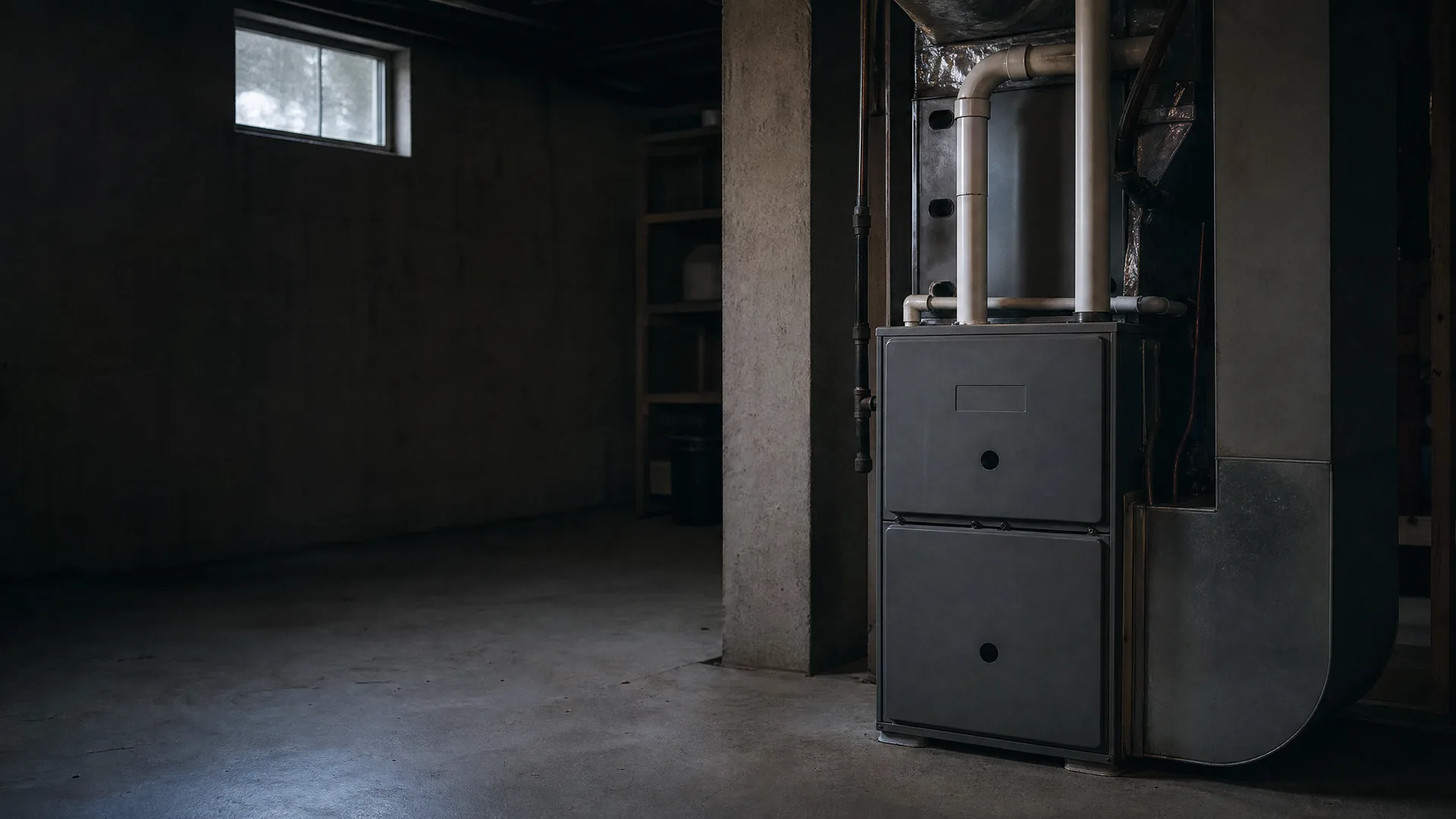
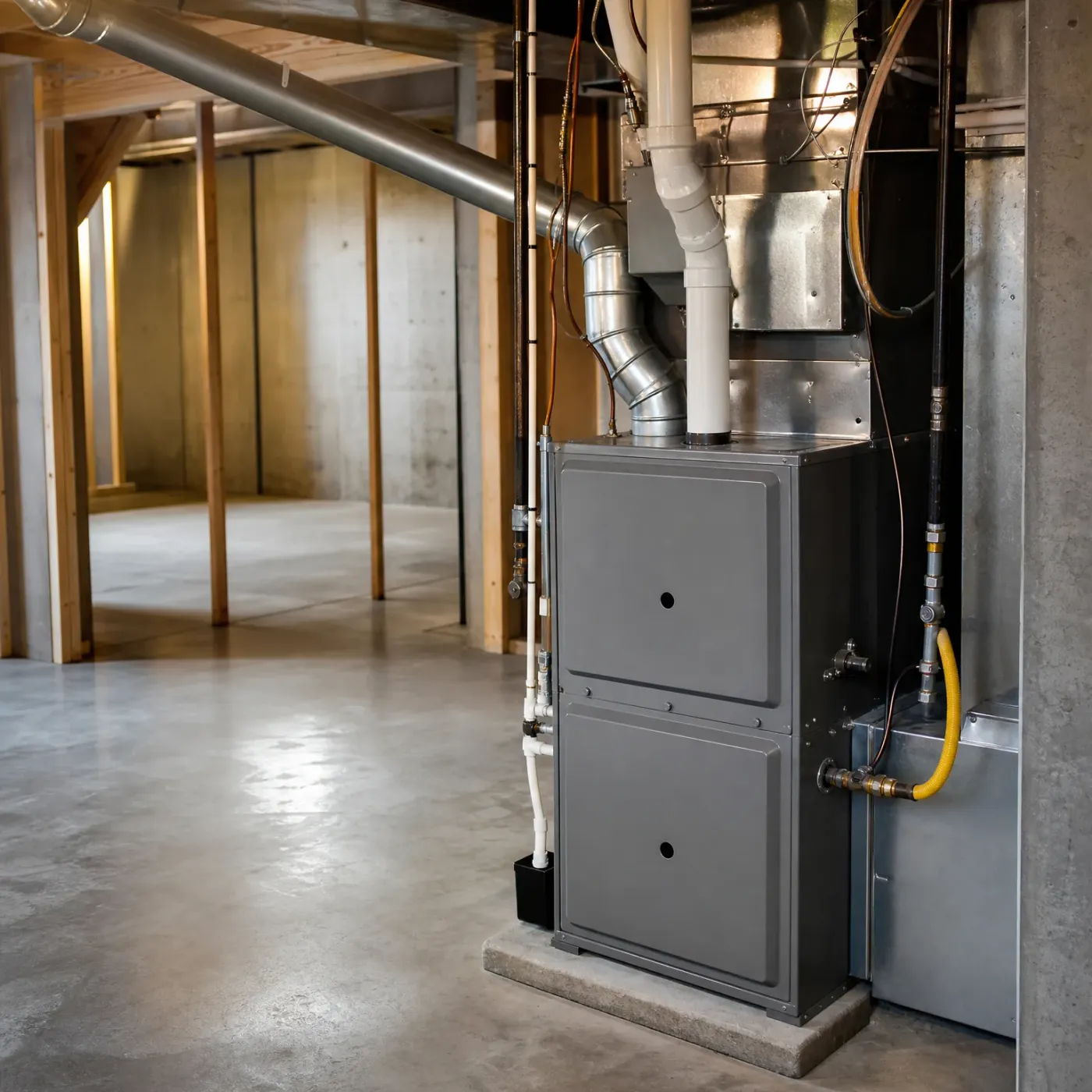
A gray high-efficiency furnace with white PVC vent pipes and attached ductwork stands beside a concrete support column in a dim, empty basement with bare concrete walls and floor and a small window.

It's just past six, dark already, and you're down in the basement because the house felt colder than it should. The furnace sits there dead quiet, no hum, no blower, nothing. You flip the switch on the side off and on again, wait, nothing happens. A thin haze of dust hangs in the air near the cabinet, stirred up from when you banged on the side of it out of habit. Upstairs your breath doesn't fog yet, but it will by morning if this doesn't get sorted. November in Monroe County doesn't wait for anyone, and neither does the cold working its way through the floor vents.

What makes a gas furnace click but not actually light?

You've gone down and heard it: a click, maybe three or four in a row, then silence. No whoosh of gas catching, no hum after. You're standing there in the cold basement trying to figure out if this is something you can fix tonight or something that's going to need a part. The clicking means the furnace is trying. Something after that click is stopping it from going further.

That clicking is the igniter trying to spark, and something downstream is cutting it off

The click you hear is the igniter or the control board attempting to start the sequence. If it clicks and nothing follows, the gas valve isn't opening, or it opens and nothing ignites it. A cracked igniter can spark weakly or not at all. A flame sensor caked with soot will also block ignition on some models, since the control board won't open the valve without a sensor reading it trusts. Low gas pressure does it too, though that's less common. In a county where January nights sit near 20°F, a furnace that clicks instead of lighting is one most people notice the same night, because the house starts losing heat fast and the cold is hard to ignore.

  1. Thermostat calls for heat and signals the control board

  2. Inducer motor starts and pulls air through the vent

  3. Pressure switch closes once airflow proves the vent is clear

  4. Igniter heats up for about 30 seconds before gas opens

A bearded man in a blue and brown plaid flannel shirt stands indoors looking out a window at snow-covered trees, with a ceramic mug on the windowsill.
A smiling man with dark curly hair in a navy t-shirt sits on a gray couch indoors, with a large-leafed plant and a window in the background.
A gray gas furnace on a concrete pad in an unfinished basement, connected to sheet-metal ductwork, white PVC venting, and a yellow gas line, with concrete walls and wood framing in the background.

Get your furnace to the right pro

Describe what your furnace is doing once, in one form.

Tell a local repair pro what your furnace is doing.

Skip the search

You're not committing to anything by asking.

Winter nights average 20°F

At 20°F, a furnace that won't light stops being a nuisance fast. A house this cold loses heat quickly once the system goes down, and pipes along outside walls are at real risk if it sits dead overnight.

NOAA nClimDiv 1991-2020

A beige high-efficiency furnace stands on a concrete basement floor beside sheet-metal ductwork, with white PVC vent pipes, flexible conduit and copper and steel piping running up a concrete wall to an electrical box.

Furnace lighting the way it should

Thermostat calls, the inducer kicks on, and a few seconds later you hear the gas catch. The burner stays lit, the blower pushes warm air through the ducts, and the furnace settles into a steady run. No clicking, no short cycling, no smell. It does this the same way every time you need it to.


An older gas furnace with a louvered front panel stands on a concrete basement floor beside large sheet-metal ductwork, a metal flue pipe, copper piping and wood framing.

Furnace that won't light

You get a click or two from the control board, maybe the inducer running, and then nothing catches. Dust sits undisturbed on the floor around a unit that hasn't fired in a while. The ductwork and gas line are all still there, ready, but the furnace itself won't cross the last step to flame.

A beige sheet-metal furnace with a louvered upper panel stands on a concrete basement floor, connected to galvanized ductwork, white PVC vent pipes, and a metal gas line with an electrical box.
Before you get your furnace repair
A gray high-efficiency furnace with white PVC vent pipes stands in an unfinished basement beside sheet-metal ductwork, gas piping, and insulated stud walls on a concrete floor.
After you get your furnace repair

Dealing with it on your own

You check the breaker, flip the switch on the side, maybe look up the model number for the filter it takes. If that doesn't work, you're searching for someone who answers the phone in the evening, explaining what you heard and what you tried, then doing it again with the next company if the first can't come out soon. Each call costs time you don't have once the house is already cold and the furnace is still dead quiet in the basement.

Getting matched with a contractor

You answer a few questions about what's happening with your furnace and a contractor who works in Monroe County reaches out to you. No listing through a dozen companies, no retelling the clicking and the smell from the vents to each one, no sorting quotes against each other while the house loses heat. The legwork of finding someone who can get to a dead furnace in Rochester is handled, so what's left is the actual repair, done by someone who showed up because you asked.

Why does Rochester's winter push a furnace to its limit?

  • Winter nights average 20°F

    Overnight lows average 20°F here in December, January and February, says NOAA. A furnace that won't light at that temperature has no slack to give before the house feels it.

  • Heat runs October through May

    Heat runs here from October through May, about eight months a year. An igniter or flame sensor gets that many more months of wear than it would somewhere with a short winter.

  • 74.6% of homes heat with gas

    74.6% of homes in Monroe County heat with gas, per Census data. That's most of your neighbors relying on the same igniter, gas valve and flame sensor that can leave a furnace clicking with no flame.

NOAA nClimDiv 1991-2020 · ACS 2020-2024

Where this leaves you

  • A furnace that clicks but won't light almost always traces back to the igniter, the flame sensor, or the gas valve.
  • Pinpointing which one it is without opening the furnace up isn't something most homeowners can do from the kitchen table.
  • Finding a contractor who picks up the phone on a cold night and actually shows up is its own separate problem.
  • Calling around, describing the clicking and the smell again to each one, and sorting through quotes takes time you don't have at 20°F.
  • Getting matched with a contractor who knows Monroe County furnaces skips the searching and the repeat explaining entirely.
  • Once you're matched, the contractor reaches out directly, so the next call you make is the last one.

A furnace that clicks and won't light is the igniter, the flame sensor, or the gas valve, almost every time. Which one it is depends on what you're hearing and smelling down there, and that's not something to guess at from upstairs. Opening the furnace up to check is a job for someone who's done it enough times to know what they're looking at.

That leaves the part you can actually do something about tonight: finding the right person. On a night when it's 20°F outside and the house is already cooling off, calling around to see who picks up isn't a small task. You explain the clicking, the smell, how long it ran before it shut off. Then you call the next one and explain it again. Then you're comparing what each of them quoted you, with half the information still missing because nobody's actually looked at the furnace yet.

Getting matched with a contractor who works on furnaces like yours in Monroe County skips that part. You answer once, and what you said gets passed along instead of repeated. The contractor who's a fit for the job calls you back, and that's the call that actually goes somewhere. No list of names to work through, no voicemail after voicemail while the house gets colder. Just the one call, from someone who already knows why you're calling.

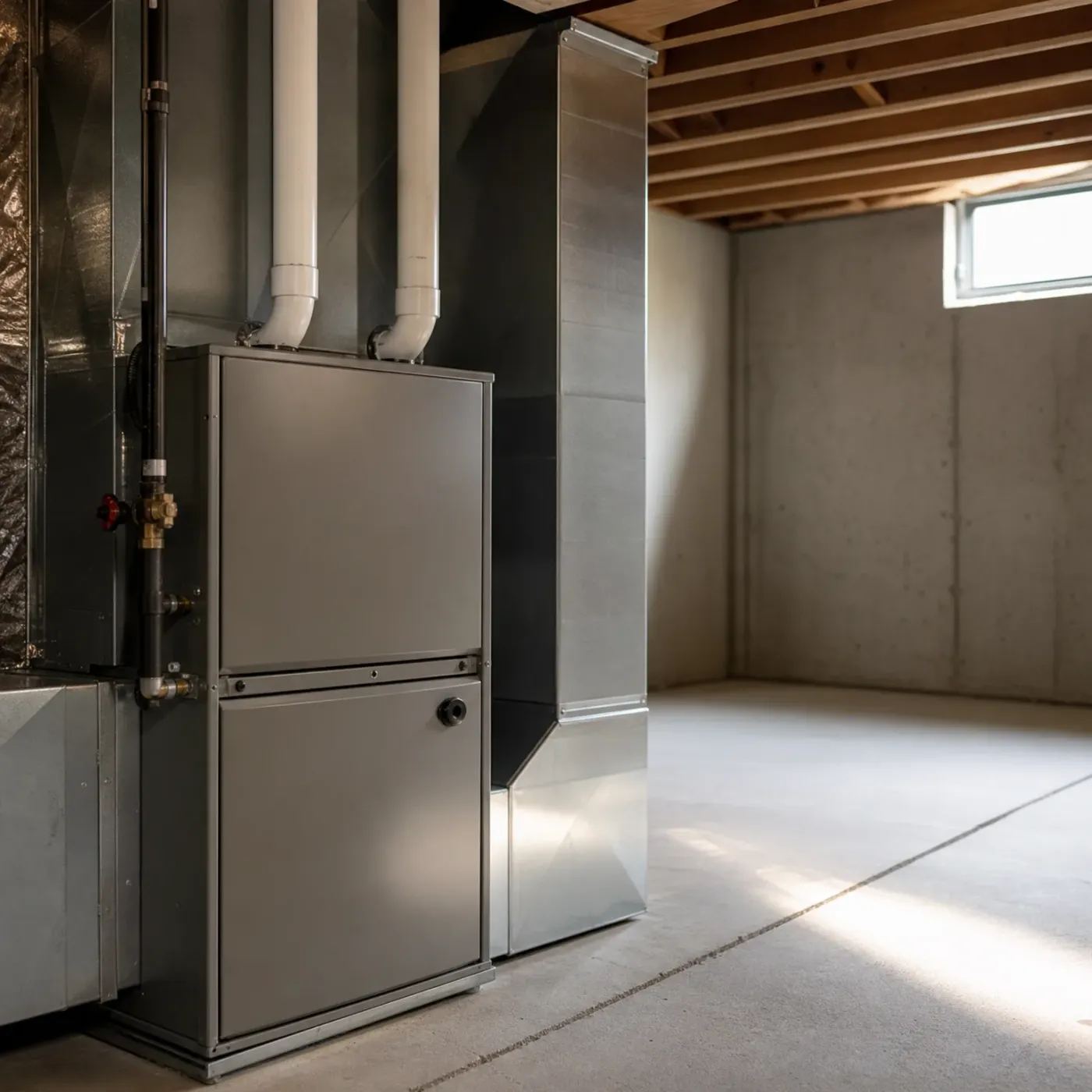
A gray furnace with PVC vent pipes and sheet-metal ductwork stands against a wall in an unfinished basement with concrete floor and walls, exposed wood joists, and a small window.

Find a furnace repair pro in Monroe County

Skip the calls

Skip calling shops to ask who repairs furnaces in Monroe County.

It costs nothing to send, and you don't have to hire anyone.