15 to 20 years
That's the typical working life of a gas furnace. One running through Erie County winters that long has earned a close look before another repair bill.

Done looking for a furnace pro
A furnace dying in January doesn't wait for a good time. This page walks through how to tell whether a repair makes sense or whether you're better off replacing it, given what gas and electric rates run here and how hard a Buffalo winter leans on a furnace. Send the form and you're done searching. One local contractor who works on these systems all winter takes it from there.
I'm done searchingA furnace that's short cycling, blowing cold air, or not firing at all can often be repaired if the heat exchanger and blower motor are still sound. But if your furnace is 15 to 20 years old, or the repair bill is running close to half what a new one costs, replacement is usually the better move. Buffalo winters run long and cold, often from November into April, and a furnace that's already struggling in December has months of hard use ahead of it. An aging furnace also tends to run less efficiently, so you're paying more for gas just to get the same heat. A repair can buy you a season, but if the cracks are showing in the cabinet or the ignitor's already been replaced once, you're likely looking at the same call again before the cold breaks. Knowing which side of that line your furnace falls on is the first step to deciding what to do next.
Nineteen degrees is the average, not the cold snap. That means most winter nights here, your furnace is fighting a 50-degree gap or more between outside and your thermostat, for hours at a stretch. An aging blower motor or a cracked heat exchanger has little room to coast when it's working that hard this often.
NOAA nClimDiv 1991-2020
A furnace under 10 years old is usually worth fixing. An igniter, a flame sensor, a draft inducer motor, a cracked wire to the thermostat, these are a few hundred dollars and an afternoon for a licensed tech. The cabinet, the heat exchanger, and the gas valve are the expensive parts to replace on their own, and if those are still good, a repair gets you back to full heat without touching the furnace's expected lifespan. If your furnace has been reliable up to now and this is the first real problem it's had, that history counts for something. One repair, even a costly one, is still cheaper than a new installation.
A furnace in its late teens that needs a new heat exchanger or gas valve is a different situation. Those parts cost enough on their own that the repair starts to compete with the price of a new, more efficient furnace, one built to handle the kind of nights Buffalo gets without straining the way an older unit does. If you've had more than one repair in the last two winters, or the furnace is short cycling in a way a tech can't fully explain, replacement stops a pattern of smaller bills adding up. A new furnace also comes with a warranty that an aging one no longer has.




That's the typical working life of a gas furnace. One running through Erie County winters that long has earned a close look before another repair bill.
A gas furnace doesn't lean on electric heat strip backup. With power costing what it does here, that's one less reason to replace it before it's done.
You probably didn't come here out of curiosity. Something's off. Maybe the furnace clicks on and shuts back off a few minutes later, over and over, instead of running a full cycle. Maybe it's blowing air that never warms up, or it's gone quiet altogether on a night you needed it most. Some furnaces get loud before they fail, a bang on startup, a rattle from the cabinet, a grinding sound from the blower. Others just get slow to catch, or the pilot or igniter clicks a few extra times before it lights. None of that is normal wear you should live with. Left alone through a Buffalo winter, a furnace that's struggling tends to struggle harder, and a cracked heat exchanger specifically can put carbon monoxide into the house, not just your heating bill.

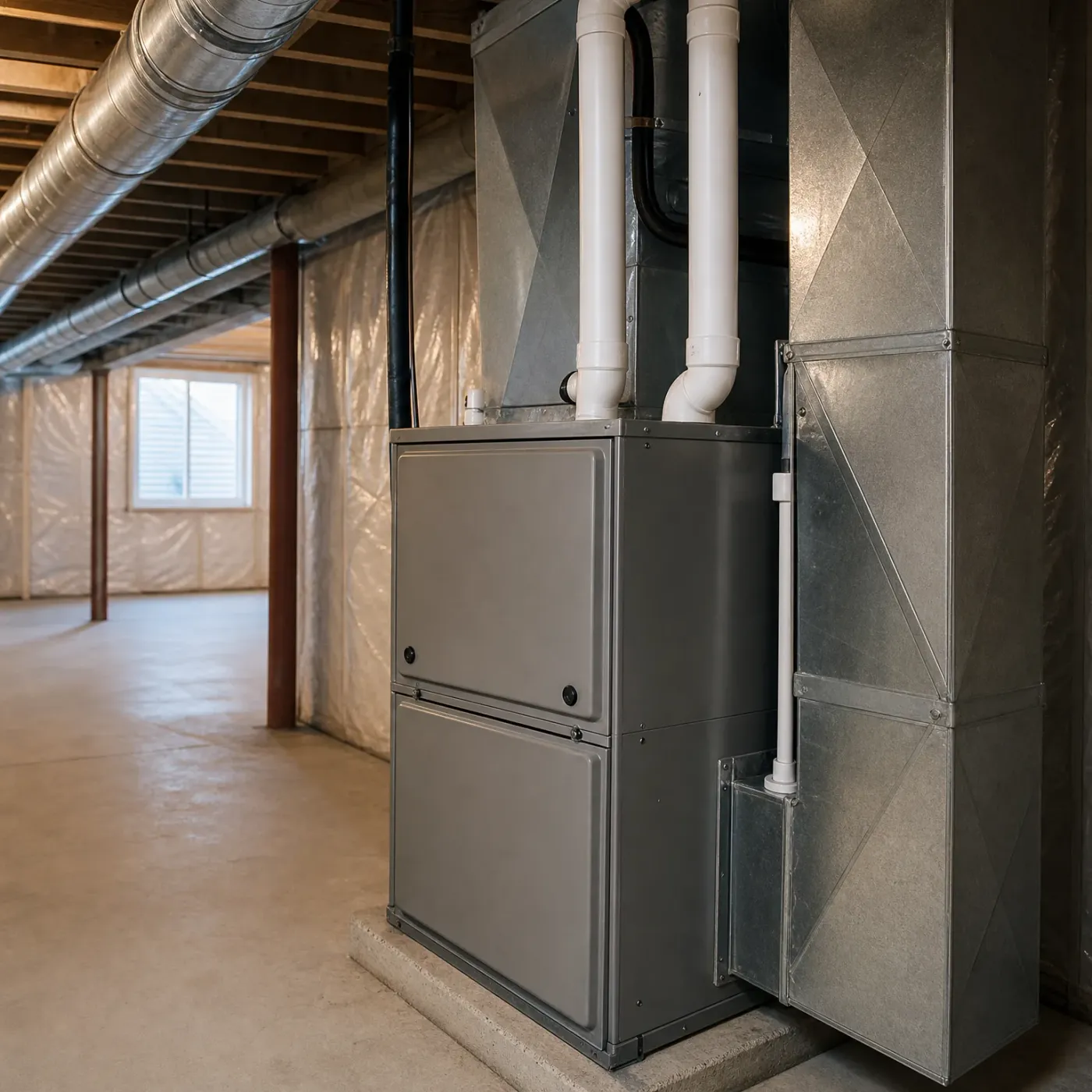
This is what a furnace looks like doing its job. The ductwork is tight, the gas line feeds it clean, and the PVC venting pulls exhaust out without strain. A unit set up like this can run a long Buffalo winter without a second thought from you.

Louvered panels like these mean an older build, and that moisture staining on the concrete behind it is worth a second look. If the furnace is also short cycling or struggling to fire, the cabinet's age is telling you something the repair bill will confirm.
Short cycling wears on a homeowner's patience fast. The furnace fires up, runs for a few minutes, shuts off, then starts again a little later, and the house never quite catches up to the thermostat setting. You want to know if that's a quick fix or a sign the furnace is on its way out.
Short cycling almost always traces back to the furnace sensing a problem and shutting itself down before it overheats or starves for air. A flame sensor coated with a thin layer of carbon can't tell the burner it's still lit, so the control board cuts the gas. A filter packed with dust chokes off airflow across the heat exchanger, and the limit switch trips to protect it. Both are an hour's work for a licensed tech. What's worth watching is how often it happens. A furnace that short cycles once in a while after a missed filter change is different from one doing it every hour, every day, which points toward a failing control board or a heat exchanger that's cracking.


The pro who reaches out is licensed in New York.
Send the request and finding a pro stops being your problem.
There's no charge for the request.



This is a furnace that's earned its keep. The gas line, the flue, and the condensate pipes are all tied in clean, and the ductwork above it is carrying heat where it's supposed to go. A setup like this holds up through an Erie County winter without much drama.

Dust on a cabinet isn't the problem by itself. What matters is what's behind it: flexible gas lines, a condensate pipe that's been patched or rerouted, a blower that's worked harder each winter than the last. A furnace like this is worth a close look before you spend more on it.
Winter nights average 19°F
19°F is the average overnight low here from December through February, so your furnace is built to recover a deep chill every night, not just take the edge off.
Heat runs October through May
October through May is eight months of the year your furnace carries the house. That's a long stretch for a weak igniter or a tired blower motor to hide.
86.8% of homes heat with gas
86.8% of homes in Erie County heat with gas, which is why most parts and most licensed techs in this area are set up to work on exactly what you have.
NOAA nClimDiv 1991-2020 · ACS 2020-2024
A furnace that's quiet most nights and only stumbles once in a while is worth fixing without much debate. One repair now doesn't tell you much about what's coming next year.
A furnace that's called a tech out twice this winter already is telling you something different. At that point you're not paying for one fix, you're paying rent on a machine that's already decided to quit.


The age of the furnace and the condition of two parts, the heat exchanger and the blower motor, decide this more than anything else. Under 10 years old with both of those sound, repair is the right call almost every time. Past 15 to 20 years, or a repair quote that's creeping up toward half the price of a new furnace, the math starts favoring replacement. Everything else, the short cycling, the cold air, the furnace that won't fire at all, is a symptom. It tells you something's wrong, not what's wrong or what it's worth fixing. That part takes a look from someone who knows what tends to fail at each stage of a furnace's life, and who's seen it happen in houses through the same Erie County winters yours sits through. That's what a local tech brings that a general search doesn't: they've opened up enough of these furnaces in January to know whether a given noise or symptom usually means an afternoon repair or a sign to start shopping. Send the request once and it goes to one contractor, licensed and local, not a list of companies bidding against each other for your number. They'll look at the exchanger, the blower, the ignition system, and tell you straight which side of the repair-or-replace line your furnace is on. Either way, you'll have an answer in one visit. Not a guess, not a list of possibilities, an answer you can act on before the next cold snap rolls through.

Only one pro gets your request, so you hear from one company.