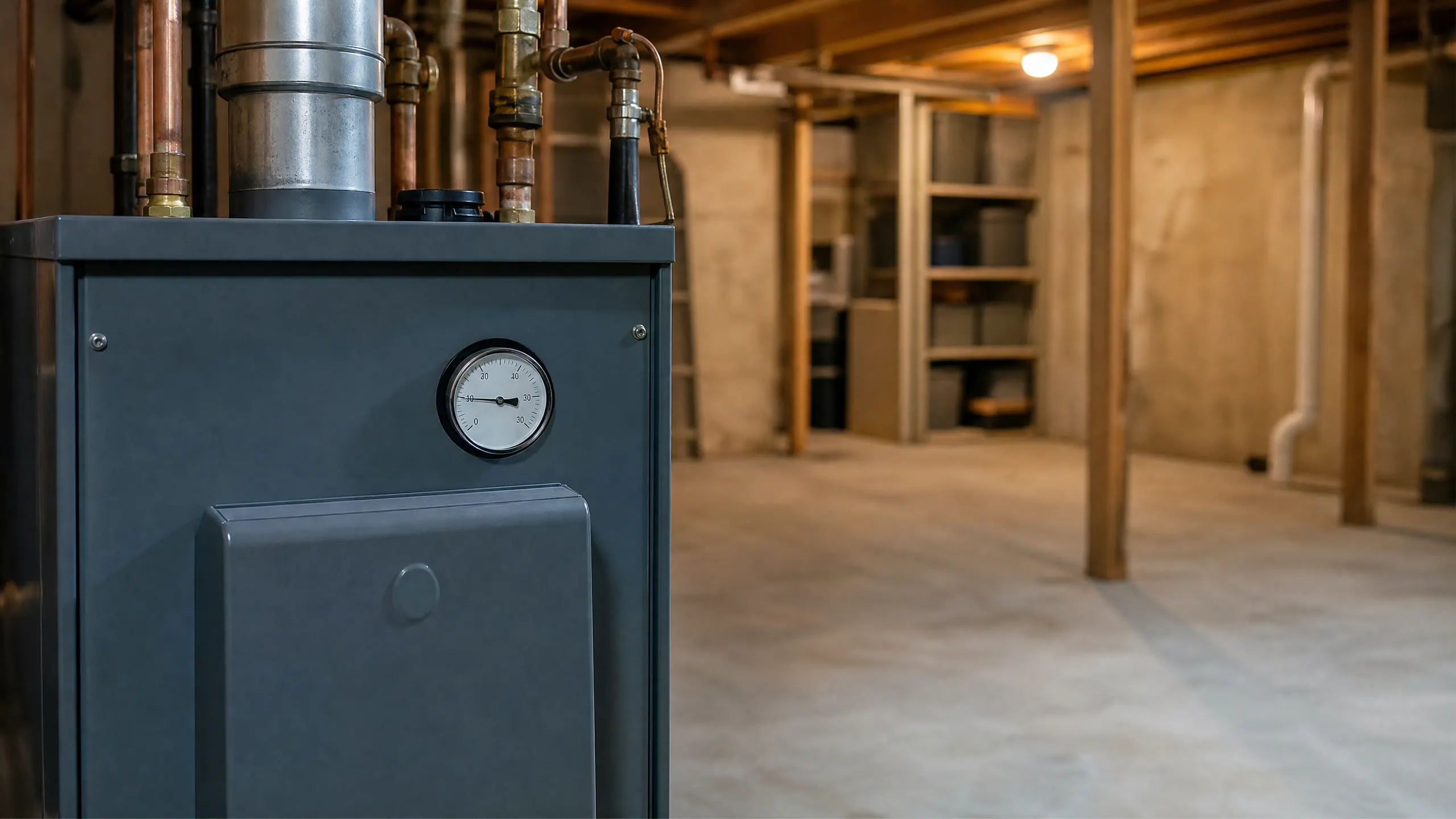





A gray boiler unit with copper pipes and a pressure gauge installed in an unfinished basement.

Boiler Repair in Spring Valley, NY

Tell us about the job

Takes about a minute. No obligation.

RepairBoilerRockland County, NY
Step 1 of 2

What ZIP code is the job in?

September is worth a look before heat goes on in October. A boiler that sat idle since spring can have a weak igniter or a circulator pump that seized up over the summer, and you won't know until it's asked to run. Homes here heat from October through May, eight months on this system, so whatever is wrong tends to show itself in the first cold week rather than waiting. If yours struggled last season, the same part is often still the problem. Getting it looked at before the first real cold snap means a repair instead of a no-heat call at night.

A small leak at a fitting won't seal itself back up by running the boiler harder.

Left alone it wears at the same joint until the pressure drops enough to shut the system down.

Half these boilers are older than the house records show

Half the homes here were built by 1971
Climate zone 5A
Heat runs October through May
Nothing about Spring Valley is hard on a boilerGas here runs $16.03 per million Btu, so a repair that's done right is worth it

Before you pay for a major repair, ask the contractor straight out how much life is likely left in the boiler. A tech who's already inside the cabinet can check the heat exchanger and look at how the burn looks, and give you a real answer instead of a guess. That matters most if your boiler came with the house, since half the homes in Spring Valley were built in 1971 or earlier and the boiler may be original. Knowing whether a repair buys you one more winter or several changes whether it's worth doing at all.

Get it looked at early

Problems tend to show up in the first weeks of the season, when the load hits a part that was already weak.

Find a contractor
A man in a dark cap, gray T-shirt and brown work pants walks up porch steps toward a dark front door, carrying a canvas tool bag filled with tools, with a potted shrub beside the entry.

Most failures trace back to a few parts

A boiler's igniter or pilot assembly wears out from repeated heat cycles. The circulator pump can seize if it sits unused for months, since the bearings dry out. A failed thermocouple or flame sensor will shut the burner down as a safety response, not because anything dangerous is happening. These are wear items, not design flaws. Every boiler eventually needs one replaced.

What a tech is checking for

No ignition, no heat, a pump that hums but won't turn, short cycling. Signs like these usually point to one part, and a tech can often confirm which one within the first few minutes of looking at the burner and the pump. The harder question sits underneath those parts, in the heat exchanger itself. Whether that's still sound is what decides if the repair is worth doing.

Before you call, check a few things yourself. Look at the pressure gauge on the front of the boiler. If the needle sits near zero, the system has lost water somewhere and needs a look. Check the thermostat has fresh batteries and is actually set to call for heat. Look for a reset button near the burner compartment, usually red, and if it trips again right after you press it, leave it alone rather than holding it down. If you have a standing pilot, check that it's lit. Check that the service switch, often a light switch on the wall near the boiler, hasn't been bumped off. None of this fixes a cracked heat exchanger or a seized pump, but it rules out the simple stuff before anyone comes out.

A diagnostic visit starts before any panel comes off. A tech watches the boiler run through a full cycle, since some faults only show up partway through the sequence. They check the pressure and look for scale or soot that points to how the water or the burn has been behaving over time. Reading the flame itself tells them a lot. A weak or uneven flame can mean a dirty burner or a gas supply problem, not just a bad igniter. Wiring and connections get checked too, since a loose connection can mimic a failed part and send someone chasing the wrong fix. Only once those line up does the tech call out a part by name and explain why it failed.