




A long white picket fence runs along a grassy lawn in front of a row of gray clapboard houses with pitched roofs, framed by large leafy trees.

Boiler Repair in Hudson, NY

Tell us about the job

Takes about a minute. No obligation.

RepairBoilerColumbia County, NY
Step 1 of 2

What ZIP code is the job in?

Half the homes in Columbia County were built in 1966 or earlier. If yours is one of them, the boiler may not be the original, but it's worth finding out how old it actually is. A boiler nearing the end of its life can still run, but it starts needing more frequent repairs, and each one is money toward a machine you'll replace anyway. Before paying for a big repair, ask the contractor how many years are realistically left in it. That answer should decide whether you fix it or start pricing a new one.

A boiler that bangs or kettles as it heats up has mineral buildup scaling the heat exchanger.

The burner has to work harder to push heat through that scale, and the noise only gets worse left alone.

Heat runs October through May here, and oil isn't cheap, so a boiler running poorly adds up fast

Heat runs October through May
Winter nights average 19°F
27 winter storms from 2015 to 2024

Heat runs eight months a year in Columbia County, October through May, and overnight lows average 19°F through December, January and February. That's a long stretch where a boiler can't take a night off. Winter storms hit this county often enough that a boiler already straining has little room left when one comes through. A boiler acting up in October, before the hard cold sets in, is telling you something now while there's still time to deal with it. Get a contractor to look at what's actually wrong before a storm makes the call for you.

September is the time to deal with it, before October's cold finds the weak part

If your boiler acted up at all last winter, September is worth a call. Problems tend to show up hard in the first cold weeks, right when October's load hits a part that was already weak. Getting it looked at now, before heat has to run every night, means finding out what's wrong on your schedule instead of a storm's.

Find a contractor
A man in a dark t-shirt and tan work pants, seen from behind, carries a worn canvas and leather tool bag up concrete steps toward a dark gray front door, with a potted flowering plant to the right.

What you can check yourself

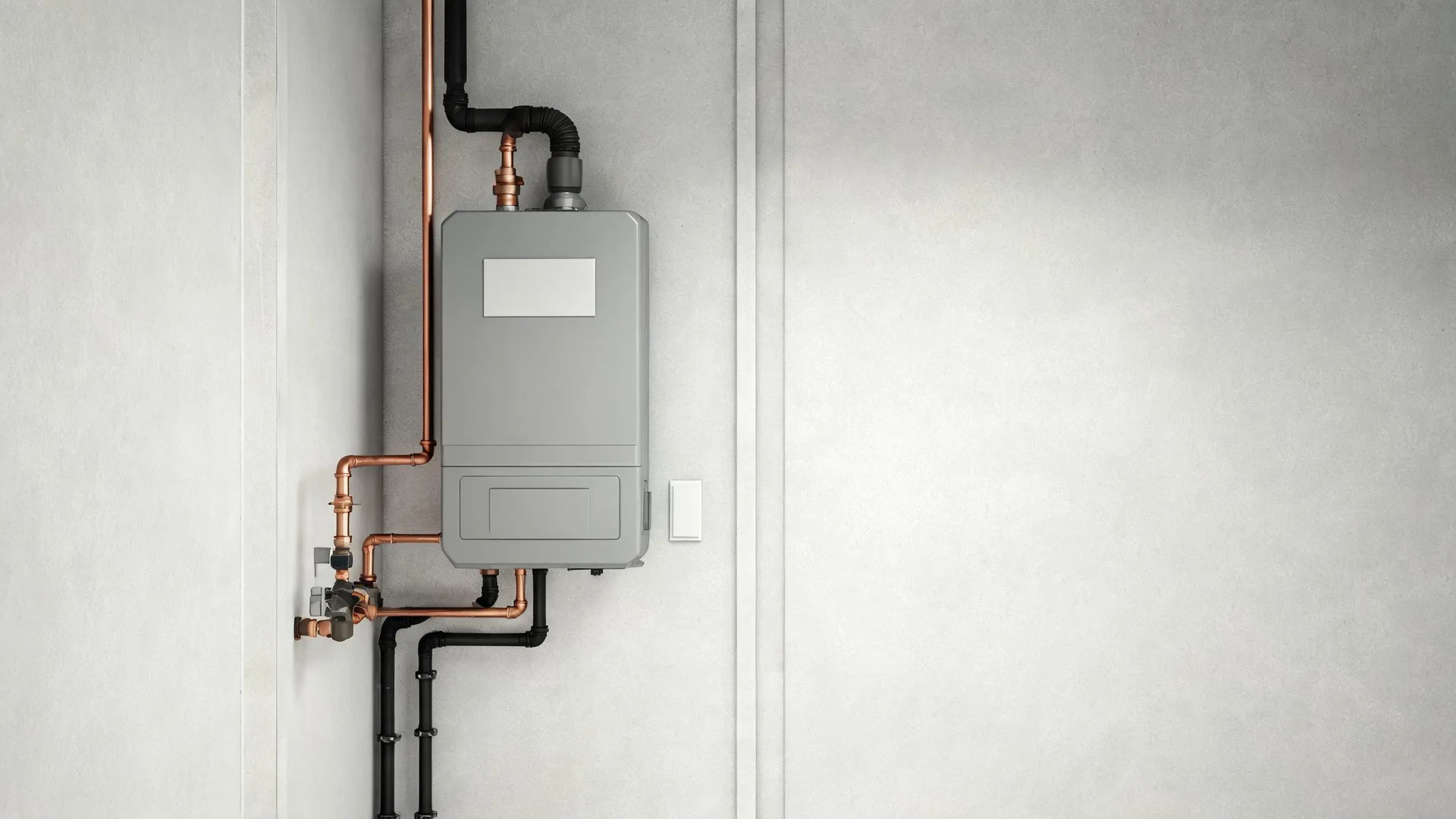
Look at the pressure gauge on the front of the boiler. It should sit somewhere around the middle of its range, usually marked in a different color. A needle sitting low or at zero means the system is low on water, and that alone can keep a boiler from firing right. Check for a reset button on the burner and press it once if the boiler's dead. If it fires and runs, fine. If it trips again, stop there and leave it off.
Where to stop and call someone

Don't keep pressing the reset button over and over if it won't hold. That usually means the burner is trying to light and failing, and repeated attempts can flood the chamber with fuel. Don't touch the gas valve or any wiring. If you smell gas near the unit, leave the house and call the gas company before calling anyone else. A contractor needs to see what the boiler is actually doing, not just hear it described.

A boiler that's losing pressure, short cycling, or struggling to reach temperature doesn't fix itself by staying on. Low water pressure means less water moving through the heat exchanger, so the parts that are firing run hotter than they should, and that's what cracks a heat exchanger over time. A burner that's cycling on and off instead of running a steady flame is lighting and relighting far more than it was built to, and every ignition wears the electrodes and the igniter a little more. Scale on a heat exchanger doesn't stay put either. It builds where the water moves slowest, and the longer the burner pushes heat against it, the more it insulates that spot until the metal underneath takes the strain instead of the water. None of that shows up as a bigger problem overnight. It shows up as a part that was marginal running fine one week and failing outright the next, usually on the coldest night of the stretch.

A contractor starts by asking what the boiler's been doing. Banging, short cycling, a pilot that won't hold, no heat at all, that history points to where to look first. Then they watch it run through a full cycle instead of going on what they're told. A burner can light clean once and still be the one that trips out later in the same run. They'll check the pressure, watch the flame, and pull the panel to look at the heat exchanger and burner assembly directly. Scale, soot, a cracked electrode, a failing control board all look different once someone's actually looking at the part instead of guessing from the symptoms. The visit ends with a straight answer about what's worn, what it's doing to the rest of the system, and whether it's worth repairing or not.