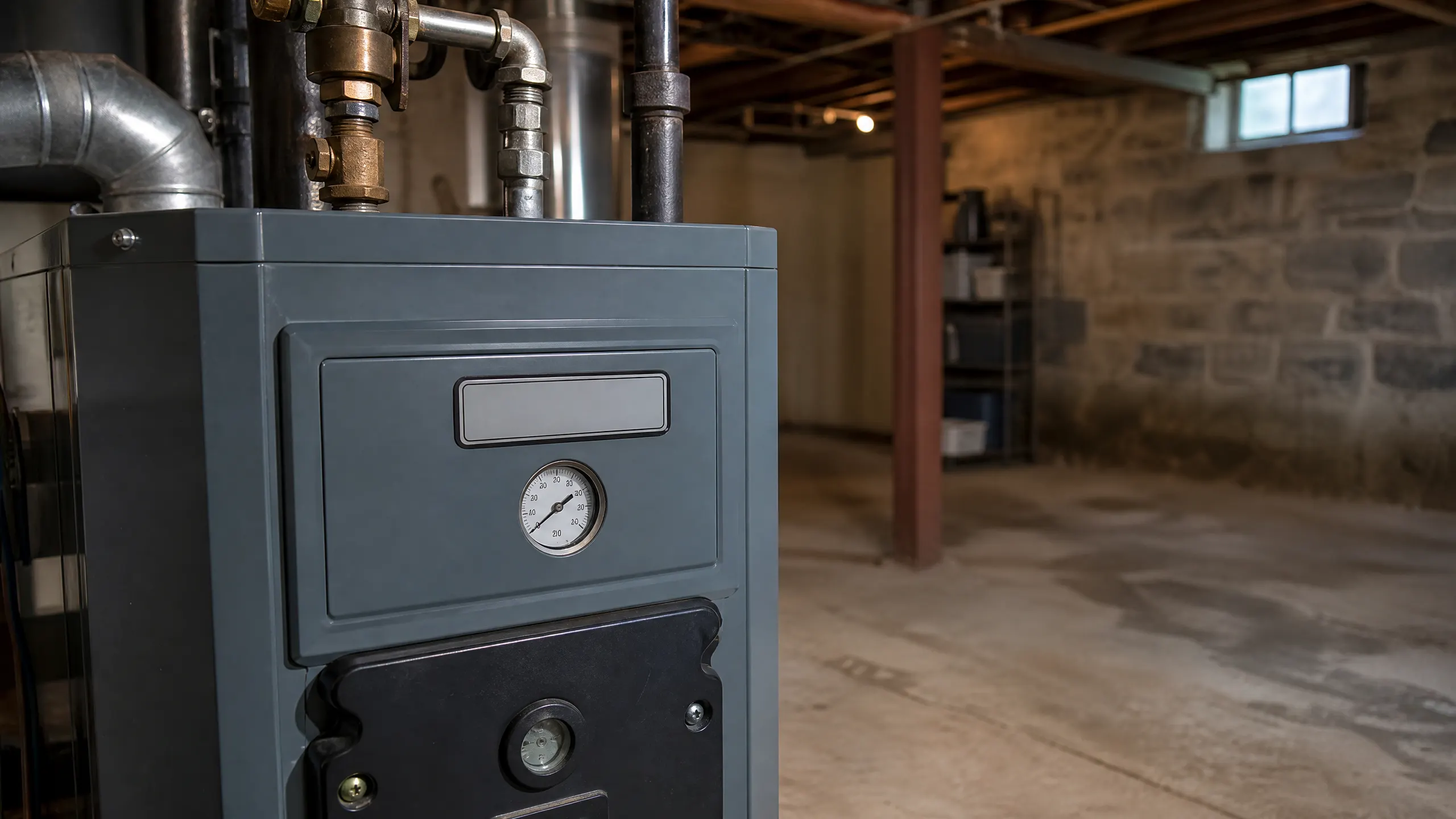





A gray residential boiler with brass pipe connections and pressure gauges installed in an unfinished stone-walled basement.

Boiler Repair in Auburn, NY

Tell us about the job

Takes about a minute. No obligation.

RepairBoilerCayuga County, NY
Step 1 of 2

What ZIP code is the job in?

Half the homes in Cayuga County were built in 1958 or earlier. A boiler that came with a house that age has likely been replaced once already, and whatever is in there now has still put in a lot of winters. Older systems develop problems in more than one place at a time, so a repair that fixes today's symptom doesn't always mean the rest of the machine is sound. If your boiler is original to the house or close to it, a cracked heat exchanger or a failing circulator isn't a one-off. It's a sign of where the whole unit is at.

Your boiler runs eight months a year here, October through May.

That's more than half the year carrying the whole house, so a breakdown is rarely bad luck. Get it diagnosed properly before deciding whether it's worth fixing again.

That boiler runs October through May on some of the costliest gas in the country

Heat runs October through May
Winter nights average 19°F
32 winter storms from 2015 to 2024
October is when a weak boiler gives outHeat goes on in October here, and whatever didn't survive last winter shows up fast.

A boiler that's short cycling, losing pressure, or not holding a steady temperature is still burning gas to get nowhere. At $16.03 per million Btu, that's expensive gas to waste. A unit running under load with a bad zone valve or a fouled heat exchanger uses more fuel to make less heat, and you're paying for every bit of it. Get it looked at before another cold stretch finds the problem for you.

Ask how much life it has left

If your system came with an older house, it may be near the end of its life. Ask how much life it has left before paying for a big repair.

Find a contractor
A man in a dark shirt and brown work pants, seen from behind, carries a worn canvas tool bag up porch steps toward a dark front door, with a potted shrub to the right.

What you can check yourself

Look at the pressure gauge on the front of the boiler. Most want to sit somewhere around the middle of the dial when the system is cold. If the needle is down near zero, the boiler is low on water and will struggle to build heat or may shut itself off. Check for a leak around the relief valve or near any visible pipe joints. Look at the pilot or ignition window if your boiler has one, and see if a light is blinking a pattern or glowing a color other than usual. Check that the thermostat has power and is actually calling for heat. None of this tells you what's broken, but it tells you what to say when you call.
What to leave alone

Don't open the burner compartment or touch the gas valve. Don't try to bleed a zone valve or reset a lockout more than once. If the boiler smells like gas, don't flip any switches at all, including the thermostat. Leave the building and call the gas utility first. A boiler that keeps shutting off and relighting has a reason for it, and resetting it over and over just hides the symptom a tech needs to see. If water is pooling under the unit, shut off the water feed if you know where it is, and leave the rest for someone trained on it.

A boiler that's struggling doesn't shut itself down to protect the rest of the system. It keeps firing, trying to meet the thermostat, and whatever is already wrong gets worse under load. A small leak at a fitting turns into a bigger one as the metal around it stays under constant pressure and heat. A cracked heat exchanger spreads because the crack sits right where temperature swings most each time the burner cycles. Sediment at the bottom of the tank hardens and insulates the metal above it, so the burner has to run longer to push heat through, and that extra runtime is what finally burns through a weak spot. None of this slows down because you keep the heat on. It speeds up.

Half the homes in this county were built in 1958 or earlier. If yours is one of them, the boiler in the basement now probably isn't original, but it's likely not new either. Every repair on a unit that old is a bet on how much is left in it. A new circulator or valve doesn't tell you anything about the heat exchanger sitting next to it. Before paying for another repair, ask the tech straight out how many years they'd plan on out of this unit. That answer matters more than what today's fix costs.