





A low-angle view across a mowed lawn toward a single-story light-colored house with a dark shingled roof and dark shutters, framed by large deciduous trees and a blurred shrub in the foreground under an overcast sky.

Boiler Installation in Geneva, NY

Tell us about the job

Takes about a minute. No obligation.

New system or replacementBoilerOntario County, NY
Step 1 of 2

What ZIP code is the job in?

Gas ran $16.03 per million Btu across New York homes in 2024. A boiler burns gas all winter to keep a house warm, so that price touches every month the system runs. Two boilers can heat the same house to the same temperature and still leave different bills behind, because one turns more of that gas into heat and less into exhaust. Over a winter that difference is real money, not a rounding error. When you're choosing a boiler here, the price on the sticker is only part of what it costs you.

Gas heats close to 6 in 10 homes in Ontario County.

A gas boiler replacing a gas boiler is the straightforward job here.

Eight months of heat a year wears a boiler faster than most places see

Heat runs October through May
Winter nights average 19°F
Climate zone 5A
Get it done before OctoberHeat starts in October here, so September is the month to put in a new boiler, not the month you find out the old one quit.

Ontario County falls in climate zone 5A, a cool zone where the heating load is what matters most. Any gas-fired hot water boiler installed here has to meet that standard, and since January 15, 2021, the baseline has been clear: at least 84 percent of the gas it burns has to turn into heat over the course of a winter. That rule narrows what a contractor can install. A boiler that falls short of 84 percent doesn't qualify, no matter the price on it. The ones that meet or beat that number are the ones built for a climate like this one.

Get the efficient boiler, since you're paying New York gas prices either way

Gas costs what it costs here, whichever boiler burns it. The difference is how much of that gas turns into heat in your house instead of going out the flue. Worth asking about before you sign off on a model.

Find a contractor
A man seen from behind in a dark sweatshirt and tan work pants climbs porch steps toward a gray paneled front door, carrying a canvas tool bag in his right hand, with a potted shrub to the left.

The AFUE number is a measure of waste, not just efficiency

AFUE tells you what share of the gas a boiler burns actually becomes heat in your house over a full season, with the rest going out the flue as exhaust. A boiler with a low rating loses noticeably more up the flue than one with a high rating. That number comes from standardized testing, so it holds up the same way in any house it's installed in.
A higher rating changes what the installer has to run

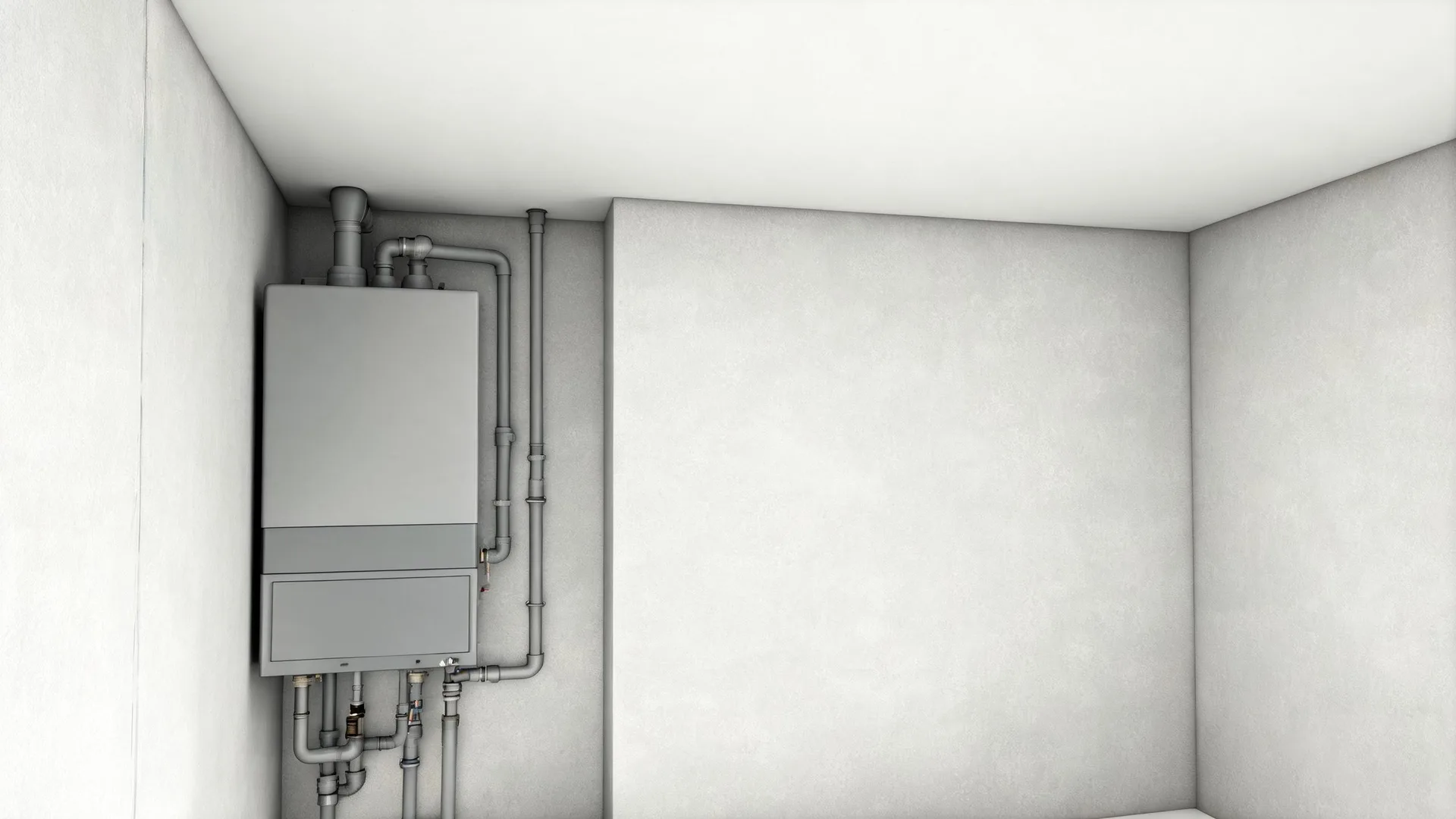
The highest efficiency boilers condense, pulling enough heat out of the exhaust that it cools below the point where moisture drops out as liquid. That condensate has to drain somewhere, and the exhaust vents through plastic pipe instead of a metal flue. A lower rated boiler skips both of those requirements. The rating on the sticker decides venting and drainage before the boiler ever fires once.

Ask what happens if the boiler you're looking at stops working on the coldest night of the year, not just what it costs today. Find out if it's a sealed combustion unit that draws air from outside through its own intake pipe, or if it pulls air from the room it sits in. Ask how many stages the burner has, since a single stage boiler runs at full fire every time it turns on, while a modulating one can throttle down and run longer at a lower flame, which means fewer cold starts and steadier heat. Ask what the warranty covers on the heat exchanger specifically, since that part is the most expensive thing in the box and the one most likely to fail from age or bad water chemistry. Find out if the circulator pump is matched to your piping or if it's a stock size the installer defaults to, because a mismatched pump either starves rooms of heat or wears out early from running against too much resistance.

Eight months of heat a year means an oversized or poorly matched boiler doesn't get an easy season to make up for. It runs October through May here, so a unit that's wrong for the house shows that mismatch for most of the year, not just during a cold snap. The fix is sizing, not brand. Ask whoever is quoting the job for a heat loss calculation on your actual house, not a number pulled from its square footage. A boiler sized off a load calculation runs longer at lower output and holds up better than one sized to match the old unit or guessed at from a price list.