










Heat pump vs oil heat in Plattsburgh, NY

I'm done searching

You are weighing heat pumps against the oil furnace heating most homes around Plattsburgh, and that is not a decision you make from a few web pages. Oil prices move, winters here are hard, and power costs more than it does downstate. What works for a neighbor's house on the next road may not fit yours. The honest answer depends on your ductwork, your insulation, and what you are paying for oil right now, and that calls for someone standing in your basement, not another article. Figuring out who does this kind of work in Clinton County, calling around, explaining your situation to each one, then sorting through quotes that are hard to compare is its own job on top of the decision itself. Send the form and that search is off your plate. You will still weigh the real choice, but you will weigh it with someone who knows both systems and your area, instead of doing the legwork of finding that person yourself.

A heat pump can work alongside your oil furnace here, but it won't replace it on the coldest nights. Cold-climate heat pumps keep producing heat well below freezing, but once temperatures drop into the single digits or lower, which Plattsburgh sees most winters, their output and efficiency fall off, and the furnace has to carry the load. That is why most installations around here pair the two: the heat pump handles the shoulder months and the milder stretches of winter, and the oil furnace kicks in when it gets genuinely cold. The payoff is on the oil bill. A heat pump run through October, November, March and April, and on the warmer days of a Plattsburgh winter, burns a lot less oil over the year than a furnace running alone. Whether it is worth installing depends on your furnace's age, your ductwork, and what a contractor finds when they look at your house.

A gas furnace with two gray access panels stands against a plain wall in a basement, connected to sheet-metal ductwork, white PVC vent pipes, and a yellow gas line.

How the pairing actually runs

A heat pump and oil furnace set up together use a thermostat that switches between them, or a dealer sets a cutoff temperature where the furnace takes over. Above that point the heat pump carries the house on electricity, which costs less to run than oil per degree of heat. Below it, the oil furnace fires, because a heat pump's output drops as the air outside gets colder and the oil burner doesn't have that problem.

A gray high-efficiency furnace in a basement corner with white PVC vent pipes, copper and black gas piping, and sheet-metal ductwork beside a plain white wall and wooden stair framing.

What the coldest nights do to it

A cold-climate heat pump is rated to keep producing heat at zero degrees and below, but the colder the air it's pulling from, the harder it works to pull the same warmth out of it. Clinton County sees stretches below zero most winters. On those nights the furnace is doing the job alone, and the heat pump outdoor unit needs clear space around it so snow and ice don't block the airflow it depends on.

Is your oil tank running out faster than it used to?

You notice it most in January and February, when the burner is firing almost constantly and the tank gauge drops faster than it did a few years back. Maybe the furnace is older now, or maybe you are just paying closer attention after last winter's delivery prices. You hear the burner kick on more often, and the house still feels like it never quite catches up on the coldest nights. None of that means the furnace is failing. It means it is doing all the work alone, the way oil systems here are built to, and every gallon it burns is one you paid for at whatever the delivery price happened to be that week.

A man in a blue sweatshirt reclines with closed eyes in a brown leather armchair in a living room with a bookshelf, houseplant, sofa, window, and a side table holding newspapers and a dark mug.
A bearded man in a gray pullover reclines with closed eyes on a brown leather sofa in a sunlit room with a window, framed picture, potted plant, and a wooden cabinet holding papers and a dark mug.
A man in a gray sweater leans back with closed eyes in a brown leather armchair beside a wooden side table holding a dark mug and a folded newspaper, with bookshelves and a window seat behind him.
A man in a green sweater reclines in an armchair with his eyes closed and a slight smile, beside a window with plants, a small table holding a mug and folded newspaper, and bookshelves behind him.

How does the furnace know when to take over from the heat pump?

You like the idea of the heat pump and furnace splitting the work, but you want to know what actually tells one to stop and the other to start. Nobody wants the furnace sitting idle while the heat pump struggles on a night when it has no business trying, or the oil burner kicking on when the heat pump could still handle the load fine on its own.

A set outdoor temperature, not the thermostat alone, makes the switch

The dealer sets a cutoff temperature during installation, often somewhere in the teens or lower depending on the heat pump model. A sensor outside reads the air temperature and reports it to a control board. Above the cutoff, the thermostat calls for heat and the heat pump answers. Once the outdoor sensor reports a reading at or below that cutoff, the control locks out the heat pump and hands the call to the furnace instead. This happens automatically, without you adjusting anything at the thermostat. Some setups let you see or adjust that cutoff point; others are fixed when installed. Either way, the switch is driven by outdoor air temperature, not by how cold the house feels inside.

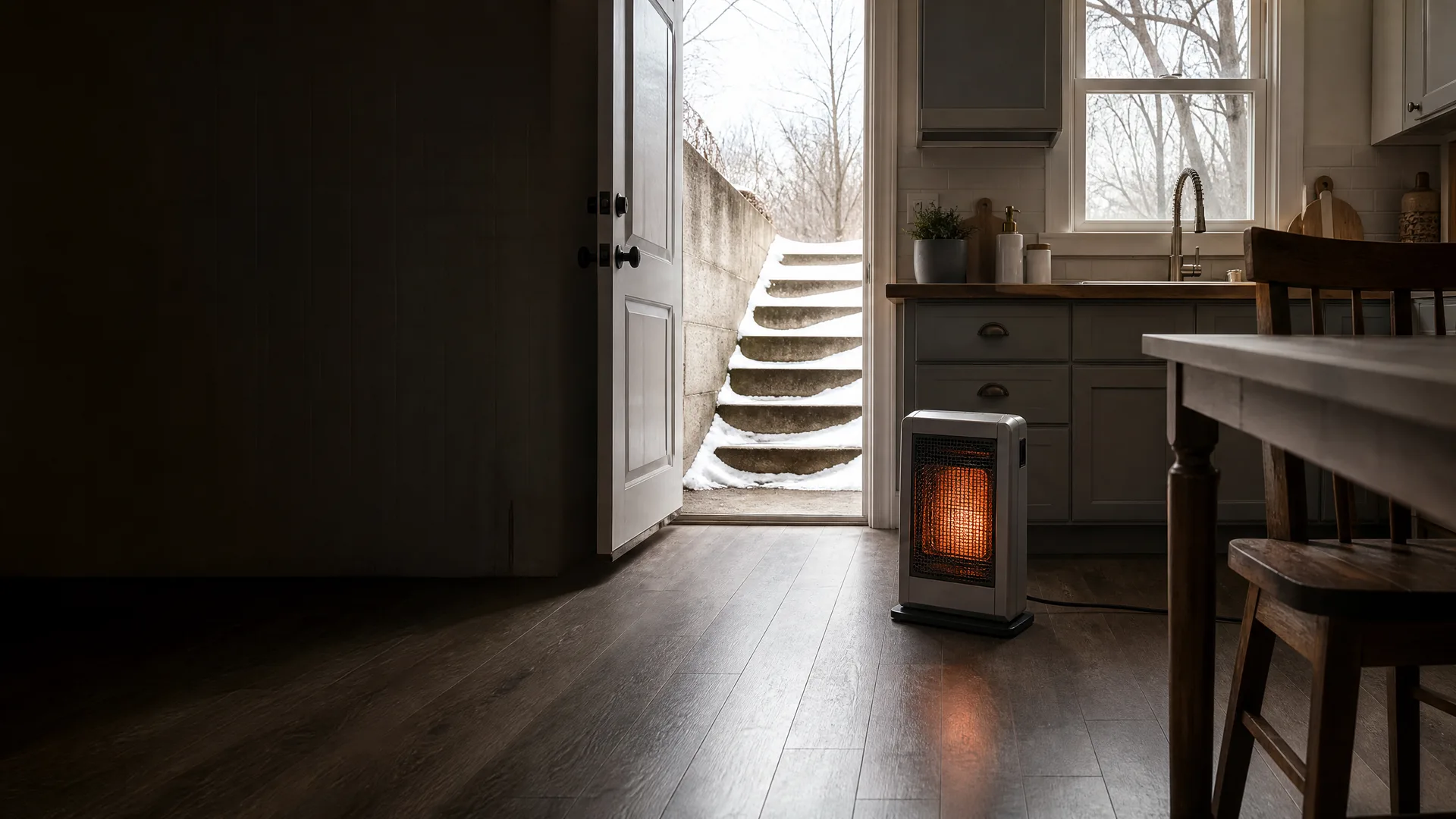
A portable electric space heater with glowing orange elements sits on a dark wood floor near an open exterior door that reveals snow-dusted concrete steps, with a kitchen counter, sink, window and wooden table to the right.

The thermostat says sixty-eight. It doesn't feel like it. It's just past six and you're in your coat at the kitchen table, the space heater humming by your feet, its coil glowing orange. The basement door is open behind you, the way you left it after going down to check the furnace, and the cold is coming up through it. Your coffee's been sitting long enough to go lukewarm. Outside the window the thermometer on the porch post reads eleven. Somewhere below you the burner kicks on again, and you sit there listening for it to catch, the way you do most mornings like this one.

A gray high-efficiency furnace with two PVC vent pipes stands in an unfinished basement beside sheet-metal ductwork, a framed and plastic-covered wall, and a bare concrete wall with vertical pipes.
The furnace is doing its job, carrying the house through a cold snap on its own.
A gray furnace cabinet in a basement, connected to galvanized sheet-metal ductwork and white PVC pipes, against a concrete wall with exposed metal piping and insulation overhead.
A furnace in good shape will run hard all winter without needing the heat pump to help.
  1. The thermostat or dealer-set cutoff reads the outdoor temperature.

  2. Above that point, the heat pump pulls heat from outside air.

  3. It moves that heat inside through the indoor coil and blower.

  4. Once the cutoff is reached, the oil furnace fires and takes over.

A gray metal furnace with two white PVC vent pipes stands on a concrete floor beside galvanized sheet-metal ductwork in a basement or utility space with wood framing.
Before you get your furnace installation
A gray furnace cabinet in a basement with sheet-metal ductwork, white PVC vent pipes, and black gas piping against a concrete wall and wood-framed partition on a bare concrete floor.
After you get your furnace installation

It's off your list after this

Answer a few questions instead of calling shop after shop.

Asking costs nothing, and the choice to hire stays yours.

Keeping the oil furnace alone

The furnace heats the house the way it always has, down to whatever the thermostat is set to, without a second system to install or learn. You keep buying oil, and the price still moves the way it always has, up some winters and down others, with no way to soften that swing. The furnace does all the work on every cold day, which means it runs longer hours and burns through the tank faster than it would if something else carried part of the load. Nothing changes about how you heat the house, for better or worse.


Adding a heat pump alongside it

The heat pump takes over on the milder days, which around here is more of the season than most people expect, and the furnace only fires once the cold gets past what the heat pump can handle. That cuts into how much oil you burn over a winter, though it won't tell you by how much without knowing your furnace and your house. You're running a second system now, with its own upkeep, and you're paying the electric bill for the hours it runs. The furnace stays as backup for the nights nothing else will do.

Winter nights average 11°F

Eleven degrees is the average night in December, January and February here, not the occasional cold snap. A furnace sized for Plattsburgh winters has to carry the house through nights colder than that average plenty of times a season, and a heat pump paired with it needs a cutoff set with that number in mind, not a guess.

NOAA nClimDiv 1991-2020

What the heat pump is doing below freezing

  • A defrost cycle runs when outdoor coil temperature and run time both hit the unit's trigger, not on a simple timer.
  • The system reverses briefly, sending hot refrigerant to the outdoor coil to melt frost before switching back to heating.
  • Indoor comfort dips for a few minutes during defrost, which is why some installers add a small electric strip to cover the gap.
  • A heat pump's capacity drops as outdoor air gets colder, so the unit works harder for the same heat output at zero degrees than at thirty.
  • The compressor modulates speed on most cold-climate units instead of just cycling on and off like a furnace burner does.
  • Refrigerant charge and outdoor coil airflow matter more in a cold-climate heat pump than in a standard model, since both affect how well it performs below freezing.

A heat pump doesn't make heat the way a furnace burner does. It pulls heat out of the outdoor air, even cold air, and moves it inside through refrigerant and a compressor. That process puts frost on the outdoor coil, especially on the damp, cold days Plattsburgh gets plenty of. The unit watches the coil temperature and how long it's been running, and when both hit a certain point, it goes into defrost. For a few minutes it reverses itself, sending hot refrigerant out to the coil to melt the frost off, which means it's briefly not heating your house at all. Some installers plan for that gap with a small electric strip that kicks in to cover it, so the air coming out of the vents doesn't go cold.

The harder the outdoor air gets, the more the unit has to work for the same amount of heat. At thirty degrees it's running comfortably. At zero, the compressor is working much harder to pull the same warmth out of thinner, colder air. Most cold-climate units handle this by modulating the compressor speed up and down rather than just switching on and off like a furnace does. How well any of this holds up depends on details that matter more in cold weather than in mild: the refrigerant charge has to be right, and the outdoor coil needs good airflow, because both affect how much heat the unit can still pull out of the air once it's genuinely cold outside.

Why does oil still make sense for a Plattsburgh winter?

  • Winter nights average 11°F

    Winter nights average 11°F here, from the National Weather Service. That's cold enough that a furnace still has to carry most of the load on its own.

  • Heat runs September through May

    Heat runs about nine months a year in Clinton County, September through May. Whatever you install here works almost year-round, not just a few cold weeks.

  • 37.3% of homes heat with fuel oil

    37.3% of homes in Clinton County heat with fuel oil, more than any other fuel, per Census data. You're not choosing against the norm by sticking with it.

NOAA nClimDiv 1991-2020 · ACS 2020-2024

A gray-haired man with a beard in a blue button-placket shirt reclines on a couch with his eyes closed, beside a sunlit window with a green plant.
A woman in a cream knit sweater sits in an armchair with her eyes closed near a window showing yellow autumn foliage, with a mug on a round wooden side table beside her.
A closed dark laptop and a ceramic mug of coffee on a wooden dining table, with wooden chairs, a dark kitchen cabinet with cutting boards and a potted plant, and a leafy plant by a window in the background.

A heat pump paired with your oil furnace, not instead of it

A heat pump sized for your house will carry the load most of the year and hand off to the oil furnace once the cold gets past what it can manage. That's the setup that fits Plattsburgh. The furnace stays as the backup that never fails you on the nights the heat pump can't keep up, and your oil bill drops because the furnace is only running part of the winter instead of all of it.

Getting there means someone sizing the heat pump to your house, setting the right cutoff with your furnace, and installing both pieces so they hand off cleanly. You could spend weeks calling around, getting contractors out for quotes, and comparing bids that all size things differently. Send the form instead and that search becomes someone else's job, not yours.

A gray upholstered sofa with a matching cushion sits beside a potted plant and a wooden table holding a small green plant in a stone pot, near a curtained window.
A dark gray high-efficiency furnace with two white vent pipes and connected sheet-metal ductwork stands in an unfinished basement with concrete walls, a support pole, and a small window.

Stop chasing a furnace pro

New system or replacementFurnace or heatingClinton County, NY
Step 1 of 2

What ZIP code is the job in?


