Most of Utica heats with gas
Utility gas heats 57.3% of homes in Oneida County, more than any other fuel. Most of these homes have a furnace or boiler already moving heat through the house.
Takes about a minute. No obligation.
Utility gas heats 57.3% of homes in Oneida County, more than any other fuel. Most of these homes have a furnace or boiler already moving heat through the house.
If gas already heats your home, a mini split is usually installed for a room the furnace doesn't reach well, or to add cooling without ductwork. It runs alongside what you have, not instead of it.
NOAA nClimDiv, 1991–2020 normals
Electricity here runs 24.43 cents a kilowatt-hour, a bit above the national average.
A right-sized mini split keeps that cost in check. There's no reason to size up.



Cooling here runs about two months, July and August, with afternoon highs averaging 78. That's not much work for a mini split to do. Winters are long and cold, but the heavy lifting there stays with the furnace or boiler already in the house. Sized to the one room it's covering, a mini split in this climate spends most of its time idle or running well below its max. There's no need to pay for the top efficiency model or the biggest unit on the lot.
Oneida County falls in climate zone 6A, with a long cold winter and a humid summer. A ductless mini-split counts as a split-system heat pump under the federal standard, so any unit made from 2023 on has to hit at least 14.3 SEER2 for cooling and 7.5 HSPF2 for heating. That sets the floor for what a contractor can install. A federal tax credit is available on top of that for units that qualify.
Find a contractor
Half the homes in Oneida County were built in 1958 or earlier. A house that old wasn't built with a mini split in mind, and whoever installs one has to work with the walls, framing and electrical panel that are actually there, not a standard setup. That affects where the line set can run and where the outdoor unit can go. It doesn't rule anything out, but it does mean the install gets planned around the house instead of the other way around.
A mini split for one room doesn't touch the heating system already running the rest of the house. Nothing about the ductwork, the furnace or the boiler changes. The old system keeps doing exactly what it was doing before, just without that room leaning on it as hard.
If this is the first ductless system in the house, there's nothing to remove or dispose of first. The job is running a new line set and mounting new units, not draining and disconnecting a failed one. Skipping that teardown is what keeps an install like this simpler than a straight swap.
A couple of numbers on a spec sheet won't tell you which system fits the room. Ask how many zones the outdoor unit supports and whether it's one indoor head per compressor or several sharing one. A multi-zone system lets one outdoor unit run several rooms, but if it fails, every room on it loses conditioning at once. Ask what happens to the indoor head if the outdoor unit needs service, and whether parts for that model are easy to get locally or special order only. Ask about the sound rating of the indoor unit too, since some run noticeably quieter than others at low fan speed. The brand name on the unit matters less than how it's sized and installed for the room it's heating and cooling.
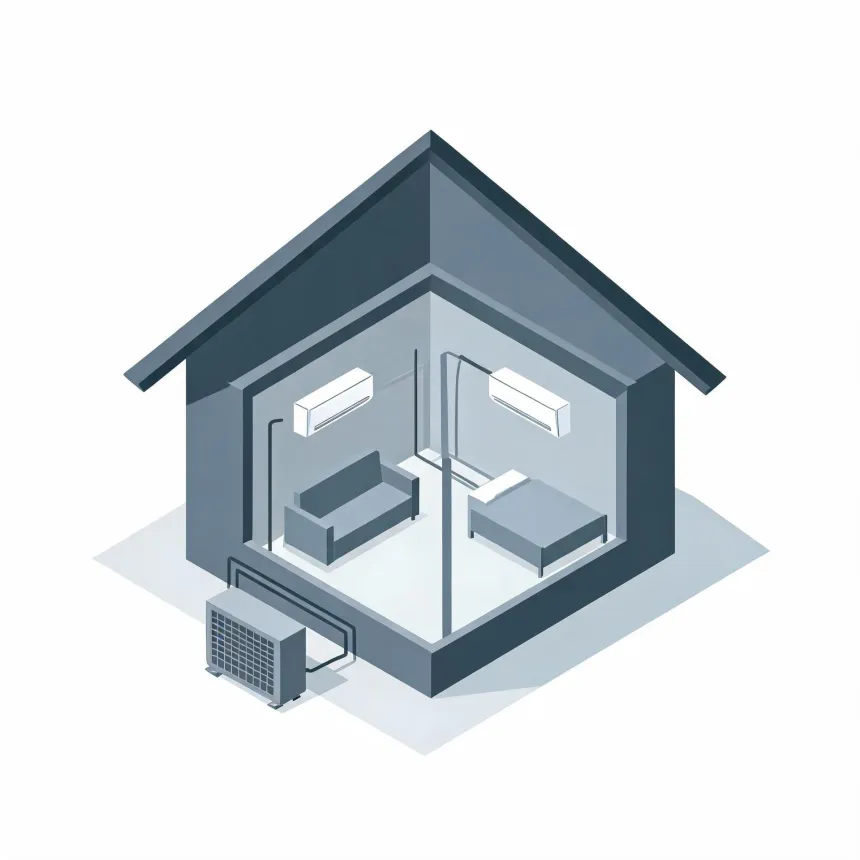
Installation starts with the outdoor unit and where it sits. The contractor mounts it on a pad or brackets, runs the line set through a small hole drilled in the wall, and connects it to the indoor head. That line carries refrigerant, so once the connections are made, the lines get pulled into a vacuum to clear out air and moisture before any refrigerant moves through them. Skip that step and the system can develop problems months later that are hard to trace back. The indoor head gets mounted high on the wall, leveled, and tied into a condensate drain so the water it pulls from the air has somewhere to go. Once everything's connected, the contractor charges the line if needed, checks refrigerant pressures, and runs the system in both heating and cooling to confirm it's holding temperature and cycling the way it should.