
Gas heats almost half of Troy
Utility gas heats 47.8% of occupied homes in Rensselaer County, more than any other fuel. Fuel oil accounts for another 20.8%.
Takes about a minute. No obligation.
Utility gas heats 47.8% of occupied homes in Rensselaer County, more than any other fuel. Fuel oil accounts for another 20.8%.
A mini split does not replace a gas or oil furnace. It adds cooling, and heat for the rooms that need it, while the furnace keeps handling the rest of the house.
NOAA nClimDiv, 1991–2020 normals
Half the houses in Rensselaer County were built in 1962 or earlier.
A mini split going into a house that age has to work with the walls and rooms already there, not the other way around.




Rensselaer County gets its share of rough weather, 301 damaging wind events and 38 winter storms in the last ten years, plus the occasional hail or tornado. None of that calls for a bigger or pricier mini split. Wind and ice threaten power lines and roofs, not the size of the unit you need to cool or heat a room. A standard mid-range system holds up the same here as anywhere else, and sizing it up won't do anything about a storm. If the power goes out, a mini split stops like anything else wired into the house, and starts back up fine once it's restored.
A standard mid-range mini split costs less to run than a bigger or higher-end one, and at 24.43 cents per kilowatt-hour, that difference shows up on the bill. Nothing about Troy calls for sizing up.
Find a contractor
Cooling here runs two months, July and August. Afternoons average 79°F in those months, which isn't a hard pull for a mini split to meet. The time-lapse shows what that looks like day to day, short runs in the afternoon heat and long stretches doing nothing at all. A mid-range unit sized right for the room handles that without strain. Ten months of the year it's either off or handling a cold snap in the room it's assigned to, not carrying the load of the house.
A contractor measures each room getting a head unit. Square footage, window area, insulation, what's on the other side of the walls. That math produces a BTU number for that room. It is not a guess based on the size of the house, and not a rule of thumb either. Rooms the same size can need different sized heads depending on how much glass they have and which way they face.
A mini split that's too big for the room hits the temperature on the thermostat fast, then shuts off. A cycle that short never runs long enough to pull much moisture out of the air, so the room reads cool but feels damp. A correctly sized unit runs longer, lower stretches that bring the humidity down along with the temperature. Bigger is not a safety margin here. It changes how the room actually feels.
What a mini split installation costs comes down to how many rooms are getting a head unit and how hard each one is to reach. A single zone system with one indoor head and one outdoor condenser is the simplest version. Add rooms and you're adding indoor heads, more line set run between them and the outdoor unit, and sometimes a second outdoor unit if one can't carry the load of everything tied to it. Where the outdoor unit sits matters too. A condenser that goes up against an exterior wall near the indoor heads is a shorter job than one that has to sit farther off, routed around windows or up through a floor. The electrical work plays into it as well. Some systems need a new dedicated circuit run from the panel, and how far that run has to go, and what the panel can take, changes the job. None of this is about the brand or the size of the unit. It's about how many rooms, how far the lines have to travel, and what the electrical already looks like before anyone shows up.
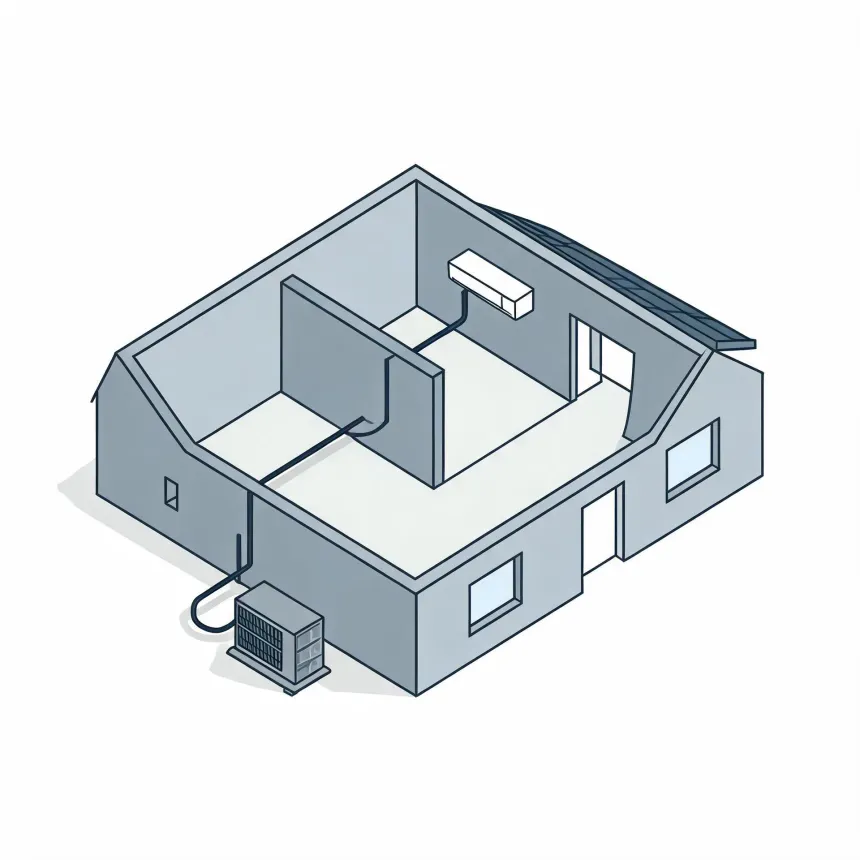
Install day starts with the outdoor unit and the indoor heads going up, then the work that connects them. A line set carrying refrigerant lines, a drain line, and electrical wiring has to run between each head and the condenser outside, usually through a small hole drilled where the wall backs up to the outdoor unit's location. Once everything is mounted and connected, the lines get pulled down to a vacuum to clear out air and moisture before any refrigerant moves through them. Skip that step and moisture left in the lines can freeze or corrode the system from the inside later. After the vacuum holds, refrigerant gets released into the lines and each head gets tested on both heating and cooling before anyone calls it done. Mounting brackets, line hide covers over the exterior lines, and a condensate path for the drain line are part of the same visit, not an afterthought.