






A row of illuminated white colonial houses with black shutters and a stone wall along a road at dusk.

Mini Split Installation in Staten Island, NY

Tell us about the job

Takes about a minute. No obligation.

New system or replacementMini-splitRichmond County, NY
Step 1 of 2

What ZIP code is the job in?

Electricity in Richmond County averaged 36.97 cents per kilowatt-hour in 2025, among the higher rates in the country. A mini split moves heat instead of burning fuel to make it, so it gets more cooling and heating out of every kilowatt it draws. At that rate, how efficiently the unit runs matters more here than it would somewhere with cheaper power. Summer air sits heavy too, with dew points averaging 63°F through June, July and August, so the system is pulling moisture out of the air as well as cooling it. Both jobs draw on the same meter.

7 months
October through April, your system heats
4 months
June through September, it cools
28°F
the average winter night it heats against
84°F
the average summer afternoon it cools against
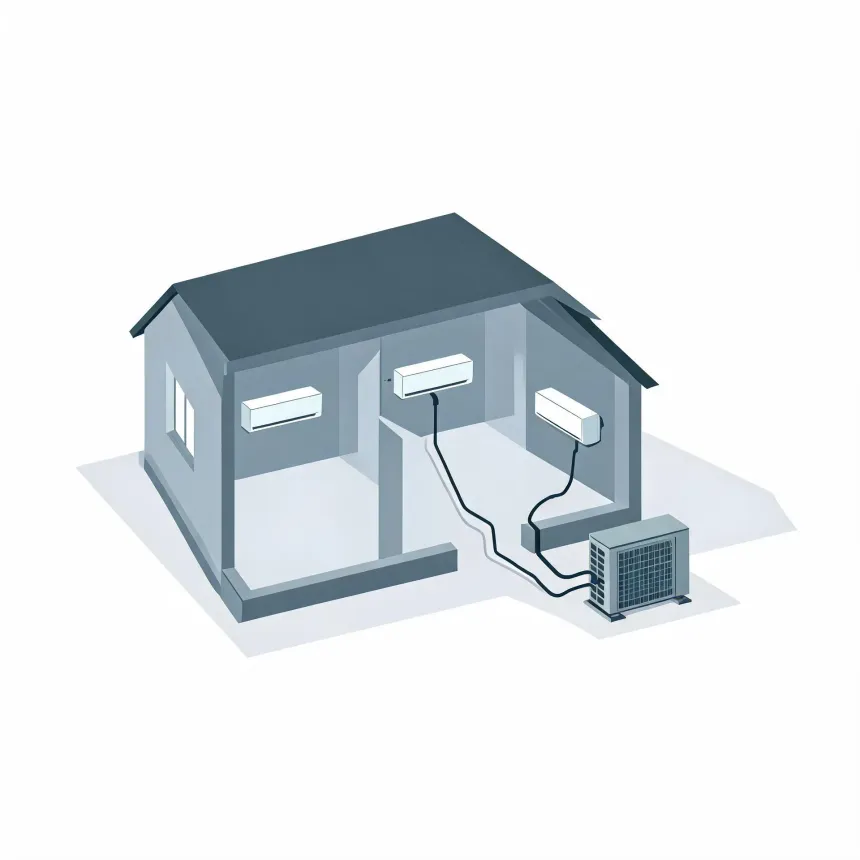
Isometric illustration of a cutaway single-story house with three wall-mounted indoor air conditioning units connected by lines to an outdoor condenser unit on the ground outside.
Your system heats October through April and cools June through September.

NOAA nClimDiv, 1991–2020 normals

A mini split sized too big cools the room fast and shuts off before it pulls the moisture out of the air.

Sizing this job means measuring the actual room, not guessing off square footage alone.

May is the month to get this installed, before June asks it to work

Cooling runs June through September
Climate zone 4A
Power here costs 36.97 cents per kilowatt-hour
Most of this county heats with gas85.1% of homes here run on utility gas, and a mini split works alongside it instead of replacing it

Staten Island falls in climate zone 4A, a mixed zone that asks real work of a system in both directions, humid summers and cold winters alike. Under the federal standard, any mini-split manufactured from 2023 onward has to clear 14.3 for cooling and 7.5 for heating, measured in Btu of heat moved per watt-hour drawn. That floor applies whether the home is adding a mini-split or replacing one. A unit that only just meets it will run fine. One built above it does the same job on less power, and on a bill already higher than most of the country, that difference doesn't stay small.

Get the efficiency right once, and it pays you back every month after

Checking the efficiency number before you buy is the one step that keeps paying off, bill after bill, for as long as the unit runs.

Find a contractor
A man in a cap, dark jacket and tan work pants carries a canvas tote bag as he steps up concrete stairs toward a blue front door, with a potted shrub beside him.
A white outdoor air conditioner condenser unit mounted on metal wall brackets against gray horizontal siding, with a blue sky and white clouds behind it.

What comes off the wall before the new one goes up

Whatever is being replaced, whether it's a window unit, an older mini split, or nothing at all, doesn't just disappear. A refrigerant line has to be recovered properly before anything comes off the wall, since that gas can't be vented into the air. If the old unit is ducted or tied into a line set that's staying in place, a contractor checks whether that line set can be reused or needs replacing before the new coil goes in. Old mounting brackets and the exterior pad for the condenser usually come out too, since new equipment rarely matches the old footprint exactly. Whatever gets hauled away is scrap, and most of it, the copper line and the metal cabinet, gets recycled rather than landfilled.

What the number on the label actually measures

The efficiency rating compares heat moved against power drawn, measured across a season rather than at one moment. A unit works hardest on the coldest and hottest days, and coasts the rest of the time. The rating averages all of that into one figure, so it tells you how the system performs across the whole range it has to handle, not just at its peak.

Why two units with the same rating still land differently

That seasonal average hides how a system behaves at the extremes. Some units hold their efficiency steady as the load gets harder, others fall off fast once it gets very cold or very humid. A higher-rated unit that's also built to vary its output rather than just switch on and off tends to hold that number closer to what the label promises, instead of only hitting it on mild days.

A few questions tell you more than the spec sheet does. Ask what the unit's minimum output is, not just its maximum. A system that can only run at full blast or off cycles on and off all day, wearing itself out and leaving the room swinging between too cold and too humid. One that can throttle down and idle at low output holds steady instead. Ask how many indoor heads one outdoor unit is meant to run, and whether that matches what you actually need, since a condenser pushed to its limit with too many zones falls short at every one of them. Ask what refrigerant line length and height difference the system is rated for, especially if the indoor and outdoor units won't sit close together. Run it longer than the manufacturer allows and the system loses capacity it was never able to make up. And ask what the warranty covers if the installer isn't the manufacturer's own certified dealer, because some manufacturers cut that coverage in half, or drop it, when an uncertified contractor does the install.

An install starts with where the lines run, not where the indoor head looks best. The copper line set and the drain line have to travel from the indoor coil to the outdoor unit through a wall, and that path gets chosen before anything gets mounted. The indoor unit hangs on a bracket, usually high on the wall, and the line set and drain run from it through a small sleeved hole to the outside. Outside, the condenser sits on a pad or wall brackets, far enough from the house to pull air freely on all sides. Once both pieces are in place, the lines get connected, and the whole system is sealed and pressure tested before any refrigerant moves through it. Only after it holds pressure does the contractor open the line and run the charge, then check the system across a full cycle before calling the job done.