
A two-story red brick house with black shutters and a dark roof stands behind a wide mown lawn, framed by large leafy trees, with a dry-stacked stone wall across the foreground.

Mini Split Installation in Spring Valley, NY

Tell us about the job

Takes about a minute. No obligation.

New system or replacementMini-splitRockland County, NY
Step 1 of 2

What ZIP code is the job in?

Electricity here runs 24.43 cents a kilowatt-hour

New York homes paid that on average in 2024. A mini split's efficiency rating matters more at that price than it would somewhere power is cheap, because every kilowatt it uses or saves shows up on the bill.

The SEER2 number is worth comparing across quotes

Two mini splits can heat and cool the same room and use different amounts of power doing it. When contractors quote different systems for this job, the efficiency rating is one real way to weigh one against another.

8 months
October through May, your system heats
3 months
June through August, it cools
23°F
the average winter night it heats against
82°F
the average summer afternoon it cools against
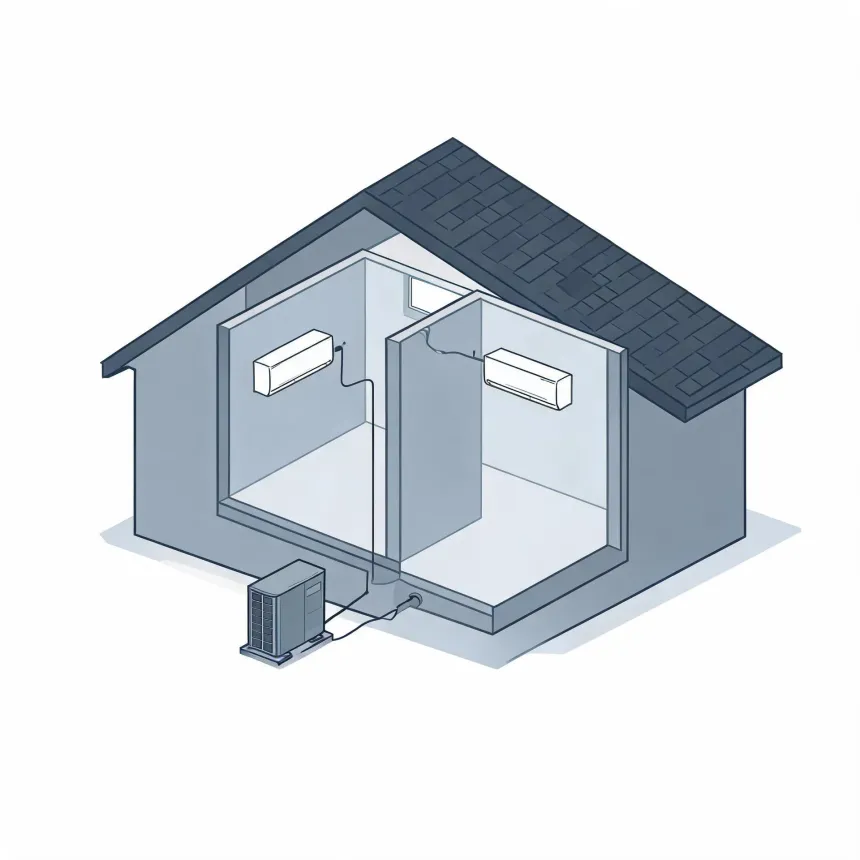
Isometric line illustration of a cutaway house with two rooms, each with a wall-mounted indoor air conditioning unit connected by lines to an outdoor condenser unit on the ground outside.
Your system heats October through May and cools June through August.

NOAA nClimDiv, 1991–2020 normals

Summer here only asks three months of work from a mini split, June through August.

A system that isn't straining most of the year holds up well, as long as it was installed and sized right from the start.

May puts a mini split in before June asks anything of it

Cooling runs June through August
Climate zone 5A
Power costs 24.43 cents a kWh statewide
Gas heats Spring Valley. A mini split takes on the rest.Utility gas heats 84.2% of homes in Rockland County. A mini split handles the cooling and the shoulder-season heating that gas doesn't.

A SEER2 rating only tells you what you'll pay if the installer backs it up with the right charge and the right line set. That's the thing to press on when you're comparing quotes at 24.43 cents a kilowatt-hour. Ask what SEER2 and HSPF2 the quoted system carries, then ask how they'll verify the charge once it's installed, since that's what decides whether you actually get that number on your bill. A higher rating quoted without that follow-through is just a number on a sticker.

Half the homes here were built in 1971 or earlier. Your mini split has to fit that house.

Half the homes in Rockland County were built in 1971 or earlier. A mini split going into a house that old has to be sized and placed for that house, not for a generic one. Whoever installs it should be looking at your walls, your windows and your layout, not working off a formula.

Find a contractor
A white outdoor air conditioner condenser unit mounted on metal wall brackets against gray horizontal siding, with a blue sky and white clouds behind it.

A system sized wrong runs wrong for as long as it's installed

A mini split installed to a sheet of specs instead of a walk-through will show it the first hot afternoon or the first cold snap, running longer than it should to hold the temperature. That's the sizing problem the action above points to, and it plays out over every one of the thousands of hours a year this machine runs. Ask whoever quotes the job how they arrived at the size, and what in your house led them there.

The old system doesn't have to come out first

A window unit or an old ductless head can usually keep running while the new lines go in. The disruption people picture, the house with no cooling for days, isn't how this normally goes.

A baseboard or wall furnace being replaced needs capping, not just removal

If the mini split is taking over for electric baseboard or a gas wall furnace, whoever pulls the old unit has to cap the wiring or the gas line properly, not just haul the unit away. That's a separate step from hanging the new system, and it's worth asking who handles it.

A mini split carries a rating for cooling and a separate one for heating, and they are not interchangeable. SEER2 tells you how much cooling you get for the power it draws over a full season of use, not just on the one hottest day. HSPF2 does the same for heating. A unit can rate well on one and only average on the other, so if heating matters to you as much as cooling, ask for both numbers, not just the one on the sticker. The rating also assumes the unit went in correctly. Oversize it or shortchange the refrigerant line and the number you actually get will fall short of the one on the label, no matter how good that label looked.

Installation day starts with mounting the outdoor unit and the indoor head, then running the line set between them, the refrigerant lines, power cable and condensate drain bundled together through a small hole in the wall. That hole gets sealed against weather once the lines are through. Before any refrigerant moves, the system gets pressure tested, so a leak shows up now instead of after everyone's gone. Once it holds, the line set is evacuated to pull out moisture and air, then charged to match the length of that specific line run, not just the number printed on the box. Last comes power-up and a test cycle in both heating and cooling, so any problem shows up while the installer is still standing there.