Gas heats most homes here
Utility gas heats 69.1% of occupied homes in Schenectady County. Most furnaces in the area run on it, with ductwork already built to move that heat through the house.
Takes about a minute. No obligation.
Utility gas heats 69.1% of occupied homes in Schenectady County. Most furnaces in the area run on it, with ductwork already built to move that heat through the house.
A mini split does not need to replace a gas furnace to be worth installing. It can take over one room or a whole addition, or handle cooling where the ductwork does not reach, while the furnace keeps doing the rest.
NOAA nClimDiv, 1991–2020 normals
Electricity in New York runs 24.43 cents per kilowatt-hour.
A mini split sized right for the room keeps that cost down. Oversizing it just to be safe does the opposite.



Schenectady County sits in zone 5A, a cool climate where heating carries the bigger load than cooling. Any mini split installed here still has to clear the federal minimum for a split-system heat pump. That means 14.3 SEER2 for cooling and 7.5 HSPF2 for heating. The standard does not treat ductless systems as their own category, so a mini split has to meet the same numbers as any other split system. Those figures are a floor, not a ceiling. A unit can beat them, but nothing sold new can fall short.
Schenectady County sees its share of wind and winter storms, but none of it points to a bigger or pricier unit. A mini split sized to the room, meeting the standard efficiency floor, is what the job calls for. Get a quote and see what fits your space.
Find a contractor
Cooling here runs July through August, about two months a year. The rest of the time the compressor sits idle. Get a mini split installed in June, before that first stretch of real heat, and any problem with the install or the unit shows up on a service call instead of the first week it's actually needed.
Sizing a mini split means working out how fast a room loses heat in winter and picks up heat in summer. That depends on the windows, how the walls are insulated, which way the room faces, and what sits on the other side of each wall. Square footage alone only gets a rough starting point. A contractor walks the room and works out the rest, because rooms the same size can call for different sized units.
An oversized mini split cools the room fast, then shuts off before it has pulled the moisture out of the air. That leaves the room cold and clammy instead of just comfortable. It also means the compressor is cycling on and off more than it should, which wears on the unit over time. Bigger is not the safe choice here. The right size is.
The SEER2 and HSPF2 numbers on a mini split tell you how much heat it moves for the electricity it uses, nothing about how big a room it can handle. A higher number means the compressor is doing more work per unit of power, which shows up as a lower electric bill over the life of the unit. But that only holds if the unit is sized right for the room. A high-efficiency mini split that is too big for the space still short cycles, still leaves the air clammy, and still wears out its compressor faster than it should. The rating tells you how well the unit converts power into heating or cooling. It does not tell you whether that unit belongs in this room at all. Both questions matter, and they get answered separately.
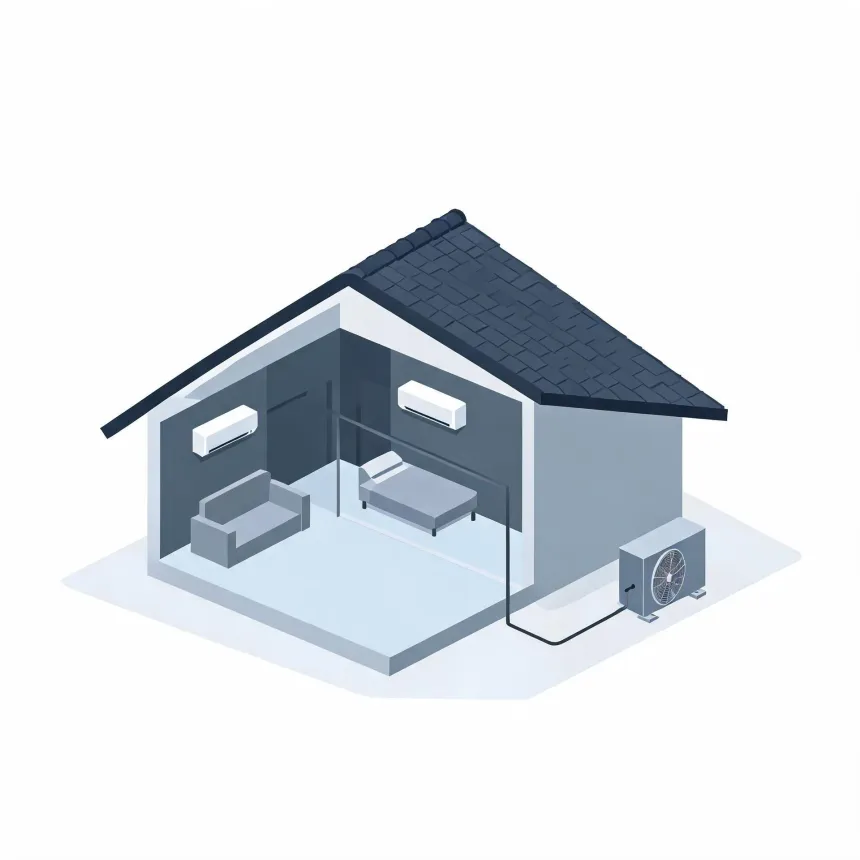
Installation day starts outside, not in. The outdoor unit needs a spot with clearance on all sides for airflow, a way to run the line set and drain to the indoor head, and a surface steady enough to hold it level. Inside, the crew mounts the wall bracket, drills through for the line set, and sets the indoor unit so the drain line can run downhill the whole way to wherever it empties out. The line set gets connected, then the whole thing is pressure tested before any refrigerant moves. Once that holds, the system gets evacuated to pull out air and moisture, because either one left behind ruins the charge. Only then does refrigerant go in, weighed to the amount the line length calls for. Last comes power, a test run in both heating and cooling, and a check that the condensate drain actually carries water away instead of pooling under the indoor unit.