





A long white picket fence curves along a mown grass strip in front of a row of gray-sided houses shaded by large deciduous trees.

Mini Split Installation in Saratoga Springs, NY

Tell us about the job

Takes about a minute. No obligation.

New system or replacementMini-splitSaratoga County, NY
Step 1 of 2

What ZIP code is the job in?

Gas heats most homes in Saratoga County, close to six in ten. A mini split doesn't replace that system, it works alongside it. Plenty of homeowners add one to a room their furnace and ducts don't reach well, like a bonus room over the garage or a finished attic. Others use it to cover the mild stretches of fall and spring, instead of firing up the furnace for a few mild days. Either way, the gas system stays in place for the coldest part of winter, and the mini split handles the rest.

9 months
September through May, your system heats
2 months
July through August, it cools
15°F
the average winter night it heats against
79°F
the average summer afternoon it cools against
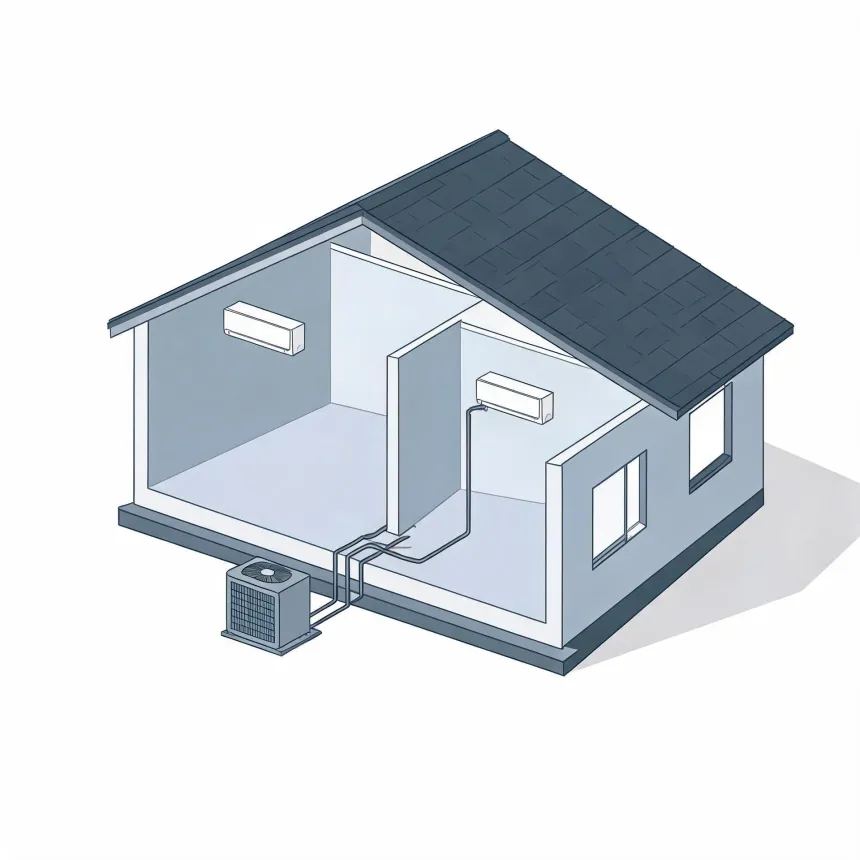
Isometric cutaway illustration of a small house with a dark shingled roof, showing two wall-mounted indoor units connected by lines running to an outdoor condenser unit beside the building.
Your system heats September through May and cools July through August.

NOAA nClimDiv, 1991–2020 normals

Cooling in Saratoga County starts in July.

Get the mini split installed before then and it's ready on day one, not mid heat wave.

A standard mini split handles Saratoga Springs summers fine

Power costs 24.43 cents a kWh statewide
Cooling runs July through August
Summer afternoons average 79°F
A standard mini split handles Saratoga Springs summers fineAfternoon highs average 79°F in June, July and August, the two months cooling runs here.

Saratoga County sees its share of severe weather, 512 events over the past decade between wind, hail, snow and the occasional tornado. None of that calls for a bigger or more complex mini split than you'd put in anywhere else. What it does call for is a clean install. A unit mounted securely and wired right will ride out a windstorm or an ice event the same as any other appliance in the house. The one thing worth planning for is power. About 11% of New York households went a full day without electricity at some point last year, and a mini split, like a furnace, won't run without it. If you're in an area prone to outages, that's a conversation to have with the installer, not a reason to upsize the equipment.

Any mini split installed here has to clear 14.3 SEER2 and 7.5 HSPF2

Saratoga County sits in climate zone 5A. Any mini split installed here now has to meet the federal minimum. That's 14.3 SEER2 for cooling and 7.5 HSPF2 for heating. There's no separate, looser standard for ductless systems, the rule treats them the same as any other split system. A unit that clears that minimum also tends to qualify for the federal tax credit on heat pumps, worth checking before you settle on a model.

Find a contractor
A man in a cap, gray shirt and tan work pants walks up steps toward a dark front door, carrying a worn canvas and leather tool bag, with a potted shrub to the right.
A beige split-system air conditioner outdoor condenser unit mounted on metal wall brackets atop a stucco wall.

What was there before just stops being needed

Whatever heated or cooled that room before, a space heater, a window unit, nothing at all, it keeps doing its job until the mini split is actually running. There's no gap to plan around. Once the new system is in and tested, the old equipment either gets pulled out or just stops getting used. A window unit comes out of the frame. A space heater gets unplugged and put away. If it was ductwork that never quite reached the room, that duct stays as it is. Nobody has to cut it off or seal it up for the mini split to do its work.

How many zones, and what's on each one

A mini split system can run a single indoor head or several off the same outdoor unit. Ask what's on each zone and why. A room on its own zone gets its own thermostat setting. Rooms grouped on one zone share a setting, even if one gets more sun or sits over the garage. More zones cost more, but the wrong grouping means one room is always a little too warm or too cold to keep the other comfortable.
What happens if one part fails

Ask whether it's one outdoor unit feeding multiple indoor heads, or a separate system for each room. With one outdoor unit serving several zones, a problem with that outdoor unit takes every room down with it. Separate systems cost more to install, but a failure stays contained to the one room. Neither setup is wrong, it just changes what a breakdown means for the house.

The indoor head on the wall is the cheap part. What drives the cost is the run between it and the outdoor unit. Refrigerant lines have to travel from one to the other, and a longer run, or one that has to climb between floors, takes more labor and more material. Cutting a sleeve through siding and framing takes longer than running a line through a chase that's already there. The outdoor unit needs its own clearance too, space on all sides and a clear path back to the indoor head that doesn't fight the way the house is built. Electrical is a separate piece of the job. A mini split needs its own circuit, and if the panel has no room left, adding capacity has to happen before the install can even start. None of that shows up on the equipment's price tag. It comes from the condition of the house the installer is working with.

Install day starts with mounting both pieces, the indoor head on the wall and the outdoor unit on its pad or bracket, before any line gets run. The refrigerant lines, drain line, and wiring all pass through a single hole in the wall between them. That hole gets sealed once everything is through it, so the gap doesn't let in air or water. Once the lines are connected, the installer pulls all the air and moisture out of them before refrigerant ever moves through. Skip that step and moisture sits in the line, which causes problems well after the installer has left. With the system charged, the installer runs it in both heating and cooling, checks that the indoor head is actually putting out a difference in temperature, and makes sure the condensate drain is draining where it should. A mini split that's working right when the installer leaves should need nothing from you but the remote.