





A gray cat sleeps curled up on a dark-made bed in a moody, minimalist bedroom with a wall-mounted air conditioning unit and warm accent lighting.

Mini Split Installation in Rochester, NY

Tell us about the job

Takes about a minute. No obligation.

New system or replacementMini-splitMonroe County, NY
Step 1 of 2

What ZIP code is the job in?

Electricity in Monroe County averaged 21.61 cents per kilowatt-hour in 2025, well above most of the country. A mini-split runs on electricity for both heat and cooling, so every hour it runs here costs more than that same hour would almost anywhere else. Summer air isn't what drives that cost. Dew points average 58°F across June, July and August, lower than most US counties, so the unit isn't fighting heavy, humid air the way it would further south. The rate on the bill is doing the work, not the humidity. A unit sized and installed right uses fewer of those expensive kilowatt-hours to do the same job as one that's oversized, undersized, or set in the wrong spot.

8 months
October through May, your system heats
2 months
July through August, it cools
20°F
the average winter night it heats against
79°F
the average summer afternoon it cools against
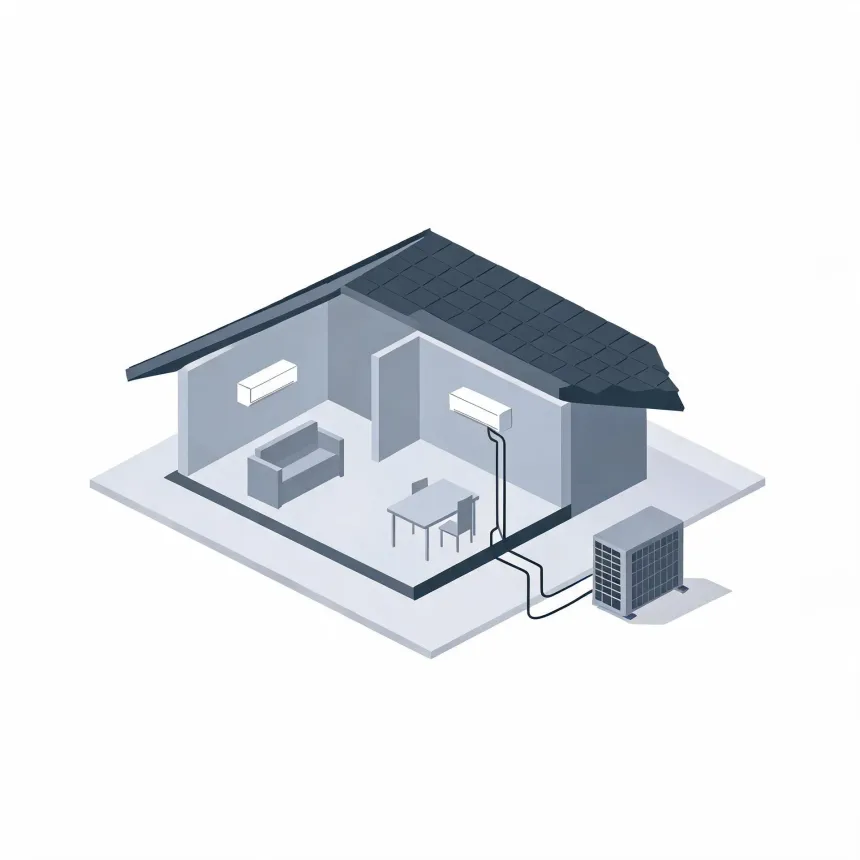
Isometric illustration of a cutaway house interior with sofa, table and chair, two wall-mounted indoor air conditioning units connected by lines to an outdoor condenser unit beside the building.
Your system heats October through May and cools July through August.

NOAA nClimDiv, 1991–2020 normals

Half the homes in Monroe County were built in 1965 or earlier.

A mini-split going into one of these houses has to be sized for that house, not for the model in the showroom.

Most homes here run on gas, and that changes what a mini-split is for

74.6% of homes heat with gas
Climate zone 5A
Power here costs 21.61 cents per kilowatt-hour
Time it for JulyCooling here runs July and August, so June is when this gets installed, not when it gets rushed.

Monroe County falls under climate zone 5A, a cool zone where the energy code assumes heating is the bigger job for any system installed here. That shapes what can legally go in. Any split-system heat pump manufactured from January 2023 on has to clear 7.5 Btu of heat per watt-hour over the winter and 14.3 over the summer, and a ductless mini-split is rated under those same split-system minimums. There's no separate, looser standard for ductless. A unit that clears both numbers comfortably is the one built for a place where winter does most of the work.

Here, an efficient mini-split pays you back on every bill

Power here already costs more than it does almost anywhere else, and a mini-split runs on nothing but power, for heat and for cooling both. Getting the size and the placement right from the start is what keeps that rate from working against you on every bill that follows.

Find a contractor
A man in a dark shirt and brown pants carries a worn canvas tool bag up concrete steps toward a gray-blue front door of a house with horizontal siding and a potted shrub.
A white mini-split air conditioner outdoor condenser unit mounted on metal brackets against a beige stucco exterior wall, with a blue sky and scattered clouds in the background.

An old house needs the right size, not the standard one

Half these homes went up in 1965 or earlier. A house that age almost never has ductwork sized for forced air the way a newer build would, and whoever installs the mini-split has to work with the walls and rooms actually there instead of a layout off a spec sheet. That means a load calculation for your house, room by room, not a number pulled from the square footage alone. Get that wrong and you end up with a unit that short-cycles because it's too big for the room, or one that runs constantly because it's too small. Either way you're paying Rochester's electric rate to run a machine that's fighting its own size.

What SEER2 and HSPF2 actually measure

SEER2 tells you how much cooling a mini-split delivers per watt-hour of power over a whole summer, not just on a mild day. HSPF2 does the same for heat over a whole winter. Both numbers come from testing across a range of conditions, mild and extreme, so a higher rating means the compressor and the coil are doing more work for the same draw on the meter, season-round, not just when the thermostat is set to something easy.

Why the rating on the box isn't the rating in the room

That label number assumes the right size unit in the right spot, charged correctly and installed to the manufacturer's spec. A unit that's oversized will short-cycle, shutting off before it finishes pulling moisture out of the air, and it'll never earn its rating doing that. One that's undersized runs flat out trying to keep up and burns through power the rated number never accounted for. The efficiency on the sticker is a ceiling, not a guarantee, and how close you get to it depends on the install.

Comparing mini-splits means comparing more than the number on the spec sheet. Ask how many zones the system supports and whether the outdoor unit can actually run all of them at once, at full output, on the coldest day you'll ask it to work. Some multi-zone systems lose capacity as you add indoor heads, so a unit that looks right for four rooms on paper may struggle once all four are calling for heat together. Ask what the turndown ratio is, meaning how low the compressor can modulate when a room barely needs anything. A system that can only run at or near full blast will short-cycle in mild weather, switching on and off rather than holding a steady low output. Ask about the line set length allowed between outdoor and indoor units, since longer runs lose capacity and some manufacturers rate it differently than others. And ask what the warranty covers if the compressor fails: parts only, or parts and the labor to replace it.

Installation starts outside, with where the outdoor unit sits. It needs clearance on all sides for airflow and a spot where snow won't bury it or drip off a roofline onto it. Inside, the indoor head goes high on a wall, away from doorways or furniture that would block the airflow across the room. The line set runs between the two through a hole drilled in the wall, usually three inches or so across, carrying refrigerant lines, a condensate drain and electrical wire inside one wrapped bundle. Once both units are mounted and the line set is connected, the installer pulls a vacuum on the lines to clear out air and moisture before refrigerant ever moves through them. Skip that step and moisture sits in the lines, and it'll cause problems with the compressor down the road. After the vacuum holds, the system gets charged, powered on, and checked zone by zone to confirm it's heating and cooling the way it should before anyone calls the job done.