A row of similar gray and white wood-sided houses with gabled roofs behind a white picket fence, with a mowed lawn in the foreground and dense green trees behind.

Mini Split Installation in Poughkeepsie, NY

Tell us about the job

Takes about a minute. No obligation.

New system or replacementMini-splitDutchess County, NY
Step 1 of 2

What ZIP code is the job in?

Weather here tests equipment

Dutchess County logged 396 severe weather events between 2015 and 2024, including 341 cases of damaging wind, 19 hail events, 28 winter storms and 5 tornadoes. An outdoor condenser sits through all of it, year after year.

Power doesn't always hold

In 2024, 11% of New York households went at least a day without power. A mini-split depends on electricity to heat and cool, so an outage that long reaches straight into how this system gets installed and backed up.

8 months
October through May, your system heats
3 months
June through August, it cools
20°F
the average winter night it heats against
81°F
the average summer afternoon it cools against
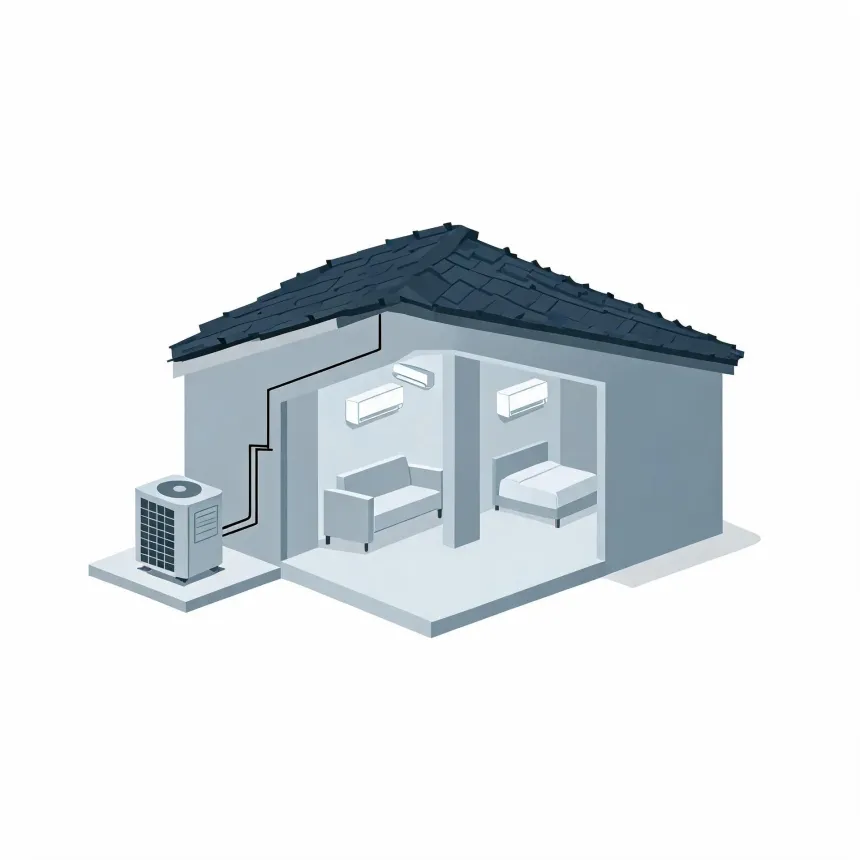
Isometric illustration of a cutaway single-story house with a dark shingled roof, showing three wall-mounted indoor air conditioning units in two rooms connected by lines to an outdoor condenser unit on a pad outside.
Your system heats October through May and cools June through August.

NOAA nClimDiv, 1991–2020 normals

Oil heats more homes in Dutchess County than any other fuel.

A mini-split installed alongside an oil furnace cuts down how much oil that furnace burns.

Cooling starts in June. Get it installed in May, before the weather and the grid test it at the same time.

Cooling runs June through August
Climate zone 5A
Power here costs 27.74 cents per kilowatt-hour

Electricity here runs 27.74 cents a kilowatt-hour, higher than most of the country pays. A mini-split that heats and cools on less power matters more in a place like this than somewhere with cheap rates. The efficiency rating on the unit is worth checking before you buy, not after. Summers in Dutchess County feel heavier than the temperature alone suggests, with the dew point averaging 61°F across June, July and August, and a system working against that load all summer shows up on the bill every month it runs. A unit sized and installed right for this house will cost less to run than one that is just big enough to get by.

Plan for the outage before the install, not during one

Where the outdoor unit goes and how the system is wired are decisions made once, at installation. A mount that keeps it clear of falling limbs, a disconnect placed where it's easy to reach, a plan for backup power if you want heat or hot water to keep running when the grid doesn't. All of that is part of the installation itself, not something to add after the first outage.

Find a contractor
A white outdoor air conditioner condenser unit mounted on metal wall brackets against gray horizontal siding, with a blue sky and white clouds behind it.

This system has to work with a house that's been standing a while

Half the homes in Dutchess County were built in 1971 or earlier. A house that age wasn't built with a mini-split in mind, and the walls, the electrical panel and the room layout all have a say in where the lines run and where the indoor units can go. None of that rules out an installation. It just means the job starts with the house as it stands, not a standard template. A contractor who sizes and routes the system for your house, not just the square footage, is doing work that matters more here than in a county full of new construction.

Sizing comes from a room by room calculation

A mini-split is sized by working out how much heat a room gains in summer and loses in winter, using its square footage, the windows, the insulation and what's on the other side of each wall. Square footage alone doesn't answer it. Two rooms the same size can need different capacity depending on how much glass they have and which way they face.

Oversized or undersized both cause problems

A unit too big for the space cools the air fast and shuts off before it pulls the moisture out, so the room feels cold and damp at once. A unit too small runs constantly and never quite catches up on the hottest or coldest days. The right size cycles on and off at a steady pace and holds the room where you set it.

The efficiency rating on a mini-split tells you how much heat it moves for the power it uses, nothing more. A higher rated unit pulls the same heat out of a room on less electricity than a lower rated one. That rating is measured under set conditions in a lab, so the number on the label is a ceiling, not a promise. How close a system gets to it depends on whether the lines are the right length, whether the refrigerant charge is correct, and whether the unit is sized to the room instead of oversized for the sake of it. A high rating on a system that's installed wrong will still run worse than a modest rating on one installed right. The rating is a starting point for comparing units, not a guarantee of what any one installation will do.

Dutchess County falls under zone 5A in the 2021 energy code, a cool zone where heating counts as the bigger load. Any split-system heat pump put in here has to meet the federal minimum for that type, built after January 1, 2023: at least 14.3 Btu of heat moved per watt-hour of electricity over summer, and at least 7.5 Btu per watt-hour over winter. That's the floor, not a target to aim for. Since winter is the heavier load in this zone, the heating number matters as much as the cooling one, maybe more, when you're comparing units. A unit sitting right at the minimum will cost more to run here than one built past it.