
A two-story red brick house with black shutters and a dark roof stands on a mown lawn behind a dry-stacked stone retaining wall, framed by large deciduous trees under an overcast sky.

Mini Split Installation in Manhattan, NY

Tell us about the job

Takes about a minute. No obligation.

New system or replacementMini-splitNew York County, NY
Step 1 of 2

What ZIP code is the job in?

The rating is about efficiency, not power

The efficiency number on a mini split tells you how much heat it moves for the electricity it uses. It says nothing about whether the unit is strong enough to heat or cool a given room. A high rating on an undersized unit still leaves a room uncomfortable.

It changes what you compare

When you're choosing between units, match the rating against the size of the space it will serve, not against another unit's price alone. A higher rated system usually costs more up front and less to run. Over the years you keep it, that tradeoff is worth working out before you decide.

7 months
October through April, your system heats
4 months
June through September, it cools
28°F
the average winter night it heats against
84°F
the average summer afternoon it cools against
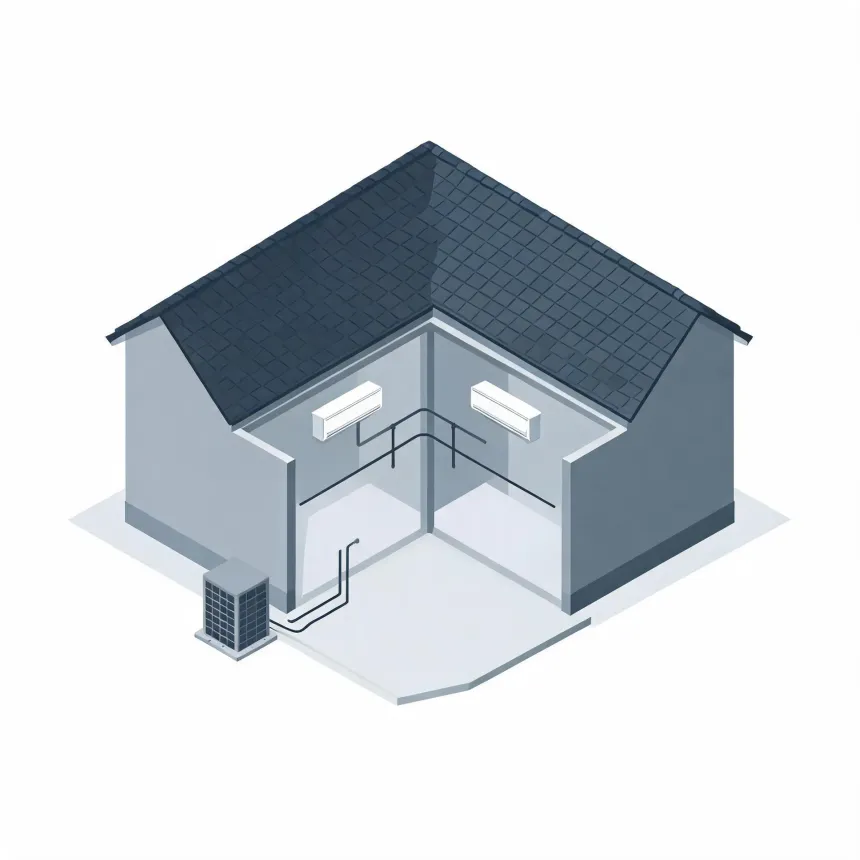
Isometric illustration of a cutaway gray house with a dark shingled roof, showing two wall-mounted indoor air conditioning units connected by piping to an outdoor condenser unit on the ground outside.
Your system heats October through April and cools June through September.

NOAA nClimDiv, 1991–2020 normals

A mini split that's too big cools the room fast and shuts off before it pulls the moisture out of the air.

Sizing comes from the room itself, its windows, its exposure, not a rule of thumb based on square footage alone.

Half these homes were built in 1951 or earlier, and a mini split has to work with the walls it's given

Half the homes here were built by 1951
Cooling runs June through September
Summer afternoons average 84°F
Most of Manhattan heats with gasUtility gas heats 48.5% of occupied homes here, more than any other fuel

Manhattan sits in climate zone 4A, which asks real work of both sides of a mini split, the heating and the cooling. Any ductless system installed here has to meet the federal minimum for that equipment class. That means at least 14.3 SEER2 for cooling and 7.5 HSPF2 for heating. This floor rules out the lower end of what's on the market, though it still leaves plenty of brands and styles to choose from. A unit that clears this bar may also qualify for a federal tax credit. Check the specific model against the current credit terms before you buy.

Get a mini split in before June, while there's still time to choose

Cooling here runs June through September. Putting a mini split in before June means it's running on your timeline, not during the first warm week when every contractor in Manhattan is booked.

Find a contractor
A white mini-split air conditioner outdoor condenser unit mounted on metal brackets against a beige stucco exterior wall, with a blue sky and scattered clouds in the background.

The line set and the wiring cost more than the unit

What drives the cost of a mini split install is mostly what it takes to get refrigerant line between the outdoor unit and each indoor head. A single zone with a short, straight run through one wall is the simplest case. Add zones, add distance, add a run that has to turn a corner or drop through a chase, and the labor goes up with it. Where the outdoor unit can sit matters too. A condenser that needs a mounting bracket on an upper floor takes more time to hang than one that sits on a pad at ground level. Electrical work adds its own cost. A dedicated circuit back to the panel and a disconnect near the outdoor unit both have to meet code no matter how simple the rest of the job is. The indoor head itself is usually the smallest part of the bill. The line set, the drain, the wall penetration, the electrical work, that's where a straightforward job and a complicated one stop looking the same.

Ask how many zones it can actually run at once

A multi-zone outdoor unit has a limit to how much capacity it can split across heads running at the same time. Ask whether the system is sized so every zone can run at once, or only sized for average use where some heads sit idle. A contractor comparing systems for a multi-room job should be able to answer this without hesitating.

Ask what happens if one indoor head needs service

Some systems link the indoor heads to the outdoor unit in a way that lets you service or replace one head without touching the rest. Others don't. If one zone's head fails years from now, you want to know whether that's a contained repair or a job that involves the whole system. Ask the question before you buy, not after something breaks.

If this is replacing an old system, whatever's hanging on the wall or sitting outside now has to come out before the new one goes in. A window unit or through-wall sleeve just gets pulled and the opening gets dealt with, patched or capped depending on what's there. If there's an old central system tied to ductwork, that part usually stays or gets capped off rather than torn out, since the duct runs aren't what the mini split uses anyway. The outdoor condenser of an old split system gets disconnected, the refrigerant recovered rather than vented, and hauled off. Any old line set left in the walls either gets reused if it's in good shape and the right size, or it gets abandoned in place and new line run alongside it. None of this is something you need to plan around. It's part of the install itself.

Install day starts outside, not in. The outdoor unit gets mounted first, on a pad at ground level or a bracket if it's going up a wall, because everything else runs from that point. Then comes the hole through the wall for the line set, sized to carry the refrigerant lines, the power cable and the drain together. The indoor head mounts to a plate on the wall, and once it's level, the line set connects to both units and gets pressure tested before any refrigerant moves. That test matters more than almost anything else in the job. A line set that leaks slowly can take months to show up as a system that just doesn't cool like it used to. After the pressure holds, the lines get charged, the system runs through its paces heating and cooling, and the installer checks the drain line actually drains instead of pooling somewhere it shouldn't.