




A two-story red brick house with black shutters and a dark roof sits on a mown lawn behind a dry-stacked stone retaining wall, framed by large deciduous trees under an overcast sky.

Mini Split Installation in Lindenhurst, NY

Tell us about the job

Takes about a minute. No obligation.

New system or replacementMini-splitSuffolk County, NY
Step 1 of 2

What ZIP code is the job in?

Suffolk County saw 566 severe weather events between 2015 and 2024. Most of that was wind, 434 events, with 82 winter storms, 10 tropical storms or hurricanes, 17 hail events and 10 tornadoes mixed in. A mini split's outdoor unit sits outside through all of it, exposed to wind-blown branches and hail in a way a furnace or boiler never is. Power loss is the other half of it. Statewide, 11% of households went at least a full day without power in 2024, and a mini split with no backup plan means no heat and no cooling until the lines are back up.

8 months
October through May, your system heats
3 months
June through August, it cools
26°F
the average winter night it heats against
80°F
the average summer afternoon it cools against
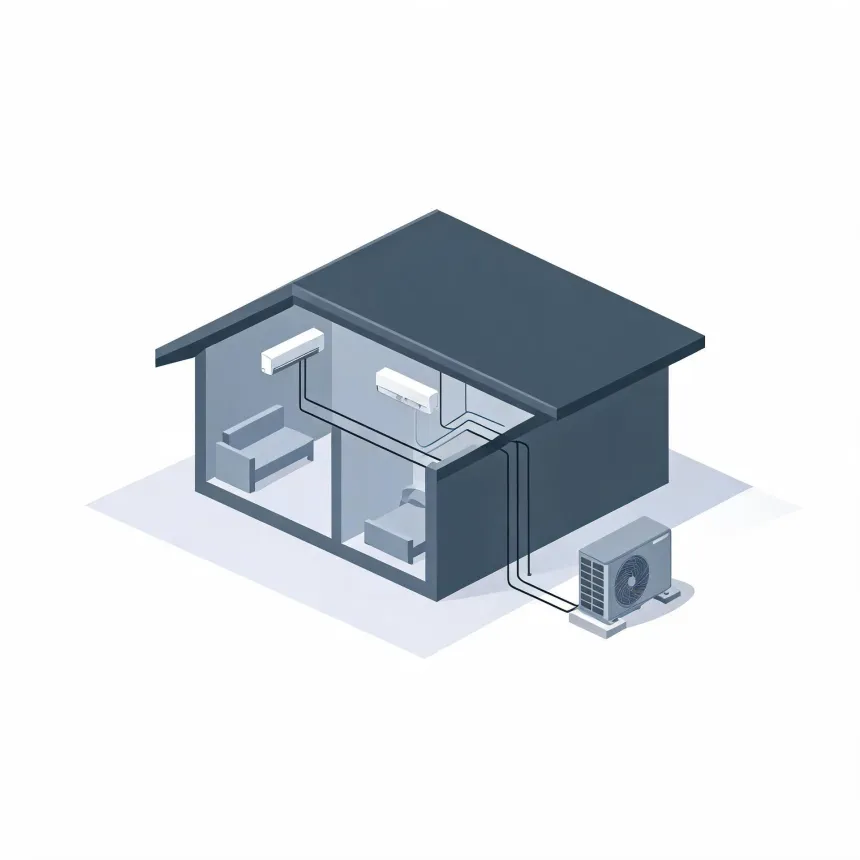
Isometric illustration of a cutaway house showing two wall-mounted mini-split indoor units connected by line sets to an outdoor condenser on a pad outside.
Your system heats October through May and cools June through August.

NOAA nClimDiv, 1991–2020 normals

Oil heats more homes in Suffolk County than any other fuel, 44 percent.

A mini split here usually goes in alongside that oil system, not in place of it, so the install has to work with what's already heating the house.

May is the month to have it in, before cooling starts in June

Cooling runs June through August
Summer afternoons average 80°F
434 damaging wind events from 2015 to 2024

Half the homes in Suffolk County were built in 1970 or earlier. A house that age wasn't built with a mini split in mind, and whatever heating or cooling got added since has usually been fitted around that original structure. The walls might have the insulation an older home typically has, and the layout may not match how a newer house splits into zones. None of that rules out a mini split. It just means the sizing and the placement of each indoor unit depend on the house you actually have, not a standard floor plan. An installer sizes the system to the rooms it has to cover, not the other way around.

Plan this install around the outages, not just the install

Where the outdoor unit goes and how it's mounted matters here, with wind and hail hitting this county as often as they do. And since a mini split runs on electricity, it's worth deciding now how you'll cover heat and cooling if the power drops for a day. Both are easier to settle before the install than after.

Find a contractor
A white mini-split air conditioner outdoor condenser unit mounted on metal brackets against a beige stucco exterior wall, with a blue sky and scattered clouds in the background.

Built for a house twice its age

A mini split installed this year runs for decades in a house that's already stood for fifty or more. Walk the rooms before the installer does. Where the old additions are, where a wall was moved, where the ductwork from the oil system stops short, that's what decides where a line set can run and where an indoor unit can actually go. Watch it through one full day into night and the house tells you more than any floor plan would.

What changes the price of the system itself

A mini split system is priced by how many indoor units it has to run and how much capacity each one needs to cover its room. A single zone costs less than a multi-zone setup with several indoor heads tied to one outdoor unit. Beyond that, the efficiency rating of the equipment matters. A higher-efficiency unit costs more upfront but puts less strain on the compressor over time. The outdoor unit's size also has to match the load it's covering. Oversizing it doesn't make a room comfortable faster, it just cycles on and off more and wears the compressor down sooner.
What drives the price of the install itself

The line set is the refrigerant line running between the outdoor unit and each indoor head, and the longer that run, the more it costs to install, especially if it has to go through a wall, a floor, or up multiple stories. Where the outdoor unit gets mounted matters too. A pad on the ground is simpler than a wall bracket that has to hold the unit level and clear of the house. Electrical work adds to it as well. A mini split needs its own dedicated circuit, and if the panel doesn't have room or the wiring run is long, that's separate labor from the mechanical install. Multi-zone jobs take longer because each indoor head needs its own line set and its own mounting, even off a single outdoor unit.

A mini split is sized by the heat it has to move, not by the square footage of the room alone. An installer works out how much heat a room gains in summer and loses in winter, counting the windows, the exterior walls, how the room sits relative to the sun, and what's on the other side of each wall. Too big and the unit cools the air fast then shuts off before it pulls the moisture out, so the room feels cold and still damp. Too small and it runs flat out all day without ever catching up on the hottest or coldest hours. Each indoor head gets sized to the room it serves, so a bedroom with two small windows doesn't need the same capacity as a sunroom with glass on three sides. The outdoor unit then has to be sized to the combined load of every indoor head running at once, not just added up on paper but checked against how the system actually balances when every zone calls for heat or cooling at the same time.

Electricity here runs 26.13 cents per kilowatt-hour on average, higher than in most of the country, and a mini split has no other fuel to fall back on. Every kilowatt it draws gets billed at that rate, so the efficiency rating on the equipment matters more here than it would somewhere power is cheap. Summer adds to the load. The dew point averages 63°F across June, July and August, which means the system is pulling real moisture out of the air on top of cooling it. A unit sized to the rooms it covers handles that without extra strain. One that's oversized for the space will cycle more and cost more to run for the same comfort, every month it's in the house.