Oil heats most homes here
Fuel oil or kerosene heats 42.9% of occupied homes in Ulster County, more than any other fuel. Gas reaches 21.0%, and most of the rest run on electricity or propane.
Takes about a minute. No obligation.
Fuel oil or kerosene heats 42.9% of occupied homes in Ulster County, more than any other fuel. Gas reaches 21.0%, and most of the rest run on electricity or propane.
A mini split does not need to replace your boiler or furnace. It handles the rooms you use most and lets your oil or gas system cover the rest, or sit idle on mild days.
NOAA nClimDiv, 1991–2020 normals
Electricity in New York runs 24.43 cents per kilowatthour, well above the national average.
A mini split's efficiency matters more here than in cheaper-power states, but a standard-size unit still covers it fine.




The price of a mini split installation comes down to how many rooms you're conditioning and how hard each indoor unit has to work to reach them. A single-zone system, one outdoor condenser feeding one indoor head, costs less than a multi-zone setup where one outdoor unit runs several heads in different rooms. Line set length matters too. The longer the run between the outdoor condenser and the indoor head, and the more the installer has to go through walls, floors or framing to route it, the more labor the job takes. Where the outdoor unit can sit also plays in. Mounting it is simple when there's a clear wall or ground space near the indoor unit, and more involved when the only option is a roof or a long way from the rooms being served. The condition of your electrical panel matters as well. Some homes need a dedicated circuit added or a panel upgrade to support the new system, and some don't.
Replace it before the season starts, so it happens on your schedule, not in a hurry.
Find a contractor
Half the homes in Ulster County were built in 1966 or earlier. A house that old wasn't built with mini splits in mind, and whatever heating it has now was probably added or replaced at some point along the way. That history matters for a mini split installation. The line set has to get from the outdoor unit to each indoor head, and the path through an older wall isn't always the one you'd plan on a clean sheet of paper. None of that rules a mini split out. It just means the install gets planned around the house you actually have.
A mini split warranty usually splits into parts coverage from the manufacturer and labor coverage from the installer. Manufacturer coverage means nothing if the installer who'd do the warranty work is no longer around or won't stand behind their own labor. Ask how long the labor is covered separately from the parts, and get it in writing.
A proper installer calculates the heating and cooling load for each room before picking a unit size, weighing the windows, the insulation, the ceiling height. If a contractor quotes a system without asking about the room first, they're guessing. An oversized unit cycles on and off too fast to pull moisture out of the air. An undersized one runs constantly and never quite catches up.
Sizing a mini split means working out the heat loss and heat gain for the room it's serving, not matching a unit to square footage off a chart. Rooms the same size can need different sized units depending on how many windows each has, which way they face, how high the ceiling runs, and what's on the other side of the walls. A room over a garage loses heat differently than one over a heated basement. An installer doing this right measures the room, checks the insulation, counts the windows, and runs the numbers before recommending a unit. Get the size wrong and the symptoms show up fast. Too big and the unit blasts the room to temperature and shuts off before it's pulled the moisture out of the air, so the room feels cool but damp. Too small and it runs flat out without ever catching up on the hottest or coldest stretches. Either way you paid for a system that can't do the one thing it's there for.
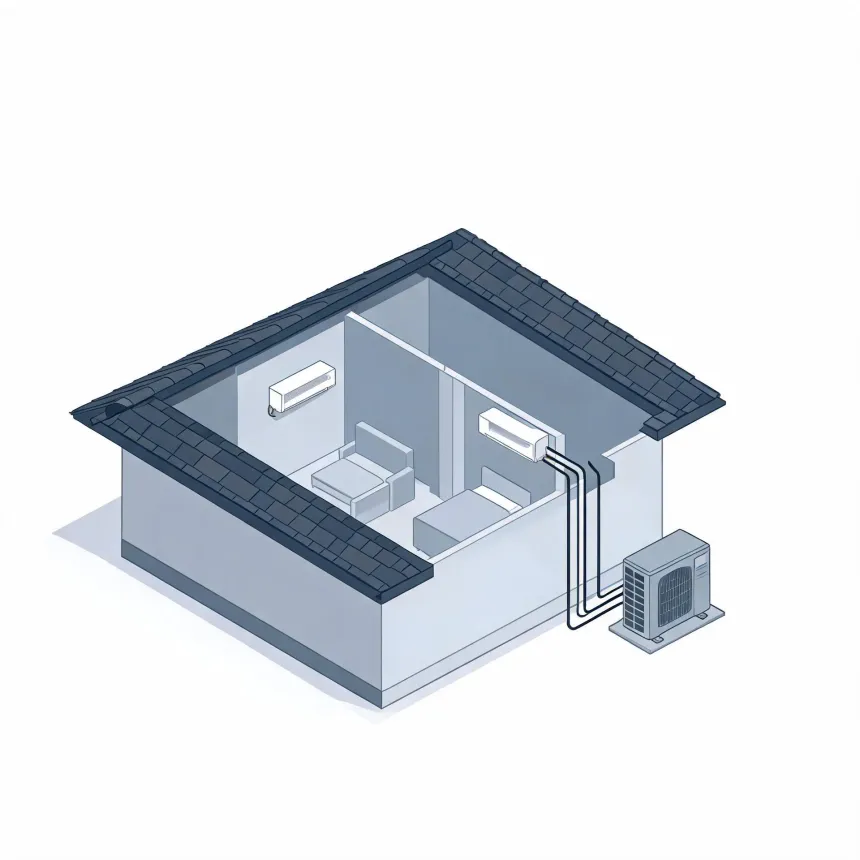
Install day starts with the outdoor condenser and the indoor head going in first, mounted and bolted in place before any wiring or refrigerant work begins. Next comes the line set, the refrigerant lines, power wire and condensate drain, run through a hole drilled where the indoor and outdoor units line up best. Once everything's connected, the installer pulls a vacuum on the line set to clear out air and moisture before refrigerant ever touches it. Skip that step and moisture left in the lines turns into acid that eats away at the compressor over time. After the vacuum holds, the system gets charged with refrigerant, tested, and run through both heating and cooling to check that the head is blowing the temperature it's set to. A multi-zone job with several indoor heads takes longer than a single-zone one, simply because each head needs its own line set run and its own vacuum and charge check before the system's done.