An orange cat sleeps on a neatly made bed with dark grey bedding in a minimalist bedroom with wall sconces and a mounted air conditioner.

Mini Split Installation in Ilion, NY

Tell us about the job

Takes about a minute. No obligation.

New system or replacementMini-splitHerkimer County, NY
Step 1 of 2

What ZIP code is the job in?

Gas heats most homes in Herkimer County

Utility gas heats 44.9% of occupied homes in Herkimer County, more than any other fuel. Fuel oil comes next at 22.1%, with electricity and propane behind that. A furnace or boiler is what most homes here already have.

A mini split works alongside what you have

If your home runs on oil or gas heat, a mini split doesn't replace that system. It adds cooling, or heating for a room your furnace doesn't reach well, like a finished attic or an addition.

9 months
September through May, your system heats
11°F
the average winter night it heats against
76°F
the average summer afternoon it cools against
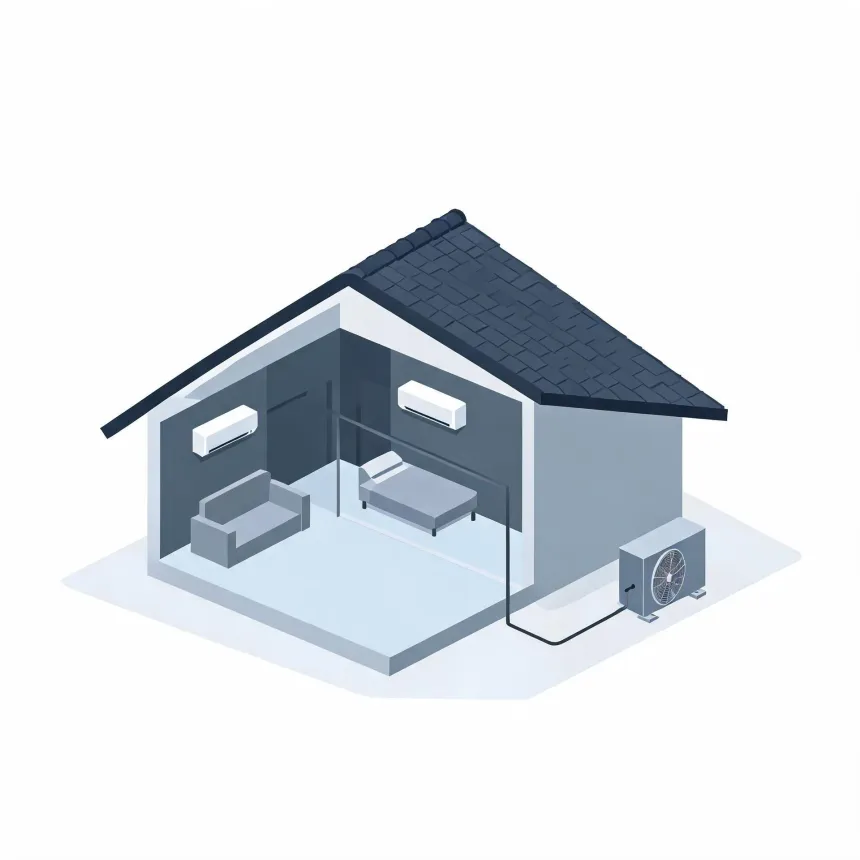
Isometric illustration of a cutaway house showing two wall-mounted indoor air conditioning units connected by a line to an outdoor condenser unit beside the building, with a sofa and bed inside.

Afternoon highs in Ilion average 76°F even in July, so a mini split isn't fighting real summer heat.

With a mild summer and a long cold stretch the rest of the year, a mid-range mini split holds up fine without paying for the top efficiency tier.

Half the homes here were built in 1954 or earlier, and a mini split has to fit the house it's going into

Half the homes here were built by 1954
Summer afternoons average 76°F
304 damaging wind events from 2015 to 2024

Herkimer County sits in zone 6A, a cold, humid zone with winter lasting months here, not just a few cold snaps. Any mini split installed counts as a split-system heat pump under federal rules, not its own separate category. That means units made from 2023 on have to hit 14.3 SEER2 for cooling and 7.5 HSPF2 for heating, at minimum. Those numbers are the floor, not a target to aim for. A federal tax credit is available on top of that for equipment that qualifies, separate from whatever the minimum requires.

A standard mini split fits this job

Electricity here runs 24.43 cents per kilowatt-hour, and a mini split's cost to run comes down to that rate and the size you pick. Nothing about Ilion calls for sizing up or stretching for the top efficiency tier. A standard size and a mid-range unit cover what this place actually asks of it.

Find a contractor
A white outdoor air conditioner condenser unit mounted on metal wall brackets against gray horizontal siding, with a blue sky and white clouds behind it.

The old unit doesn't have to fight the new one

If the old system is a window unit or a wall unit cooling one room, it usually just comes out. Nothing to drain, nothing to disconnect beyond a power cord. If what's being replaced is ductwork trying to cool or heat a room it was never sized for, that ductwork can often stay in place for the rest of the house and just stop being the plan for that one room. A mini split doesn't care what was there before. The outdoor unit and the indoor head are new equipment either way, so the old system's condition doesn't carry over or cause problems down the line. Whoever hauls it off should recover any refrigerant first if it's a sealed system, rather than venting it, since that's standard practice for a reason.

SEER2 and HSPF2 measure different jobs

SEER2 is the cooling rating, HSPF2 is the heating rating. A mini split carries both numbers because the same equipment does both jobs. A strong cooling rating says nothing about how the unit performs on a cold night, and the reverse is true too. Look at both numbers, not whichever one is higher on the label.

The rating describes a season, not a moment

The efficiency number is an average over a full season of running, not what the unit does on any single hot afternoon or cold morning. A mini split still has to produce enough heat or cooling to match the room on the worst day it faces. Sizing the unit to the room is a separate question from the efficiency tier it carries, and both have to be right.

Ask how many indoor heads the outdoor unit can run, and whether it's a single-zone or multi-zone system. A single-zone unit is matched to one indoor head and generally runs it more efficiently than a multi-zone setup split across several rooms. Ask what happens if one head needs service, and whether the rest keep running while it's worked on. Ask about the line set length between the outdoor unit and the indoor head, since longer runs can affect how the system performs and where the outdoor unit can actually sit. Ask what the sound rating is for the indoor head, since that number tells you more about living with it day to day than the efficiency rating does. And ask who handles warranty work on the compressor versus the indoor head, since on some systems that's not the same path.

Installation starts outside with where the outdoor unit sits. It needs clearance on all sides for airflow and a spot where condensate can drain away from foundations or walkways. Inside, the indoor head gets mounted high on a wall, on a bracket set level so condensate drains correctly toward the line set. A small hole gets drilled through the wall for the line set, the refrigerant lines, power wire and drain tube bundled together and run from indoor head to outdoor unit. Once everything's connected, the line set gets pressure tested for leaks before the system is charged with refrigerant and run through its paces. A tech will check static pressure, confirm the head is reading temperature correctly, and make sure the condensate drains the way it's supposed to before calling the job done.