A row of illuminated white colonial houses along a road photographed at dusk.

Mini Split Installation in Hudson, NY

Tell us about the job

Takes about a minute. No obligation.

New system or replacementMini-splitColumbia County, NY
Step 1 of 2

What ZIP code is the job in?

Storms come through often here

Columbia County recorded 438 severe weather events between 2015 and 2024, with damaging wind alone hitting 392 times and winter storms another 27. An outdoor compressor sits outside through all of it, taking wind and whatever it carries.

Outages last longer than people expect

Across New York, 11% of households went at least a full day without power in 2024. A mini split won't run without power, and neither will an oil burner's blower or igniter. Where the outdoor unit goes and how the system backs up matters as much as the install itself.

8 months
October through May, your system heats
2 months
July through August, it cools
19°F
the average winter night it heats against
81°F
the average summer afternoon it cools against
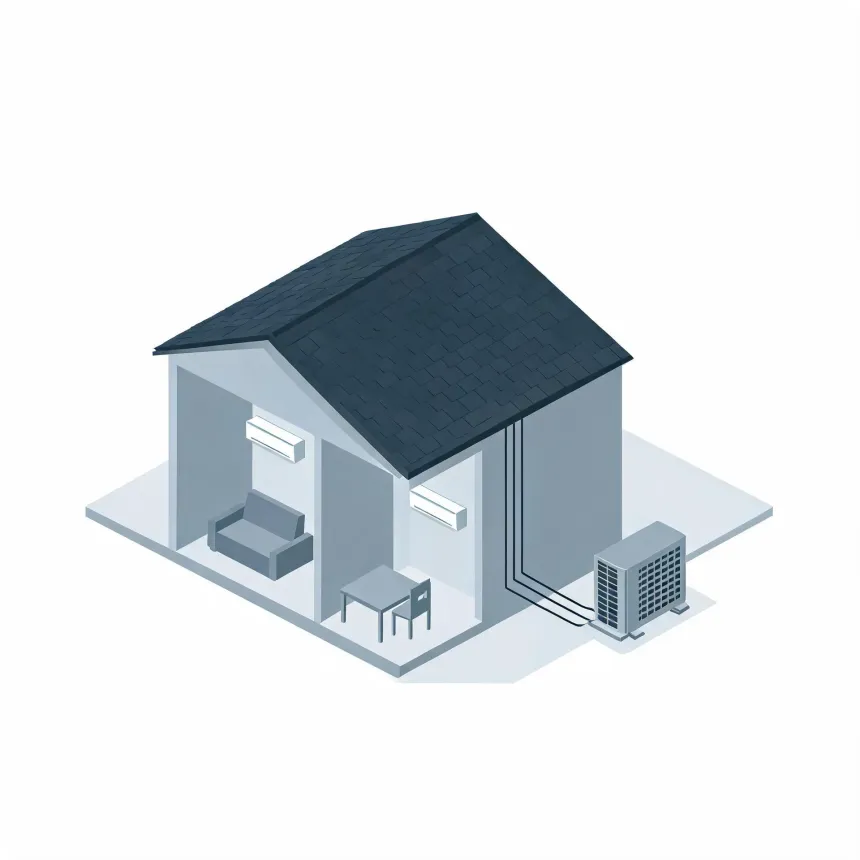
Isometric illustration of a cutaway house with a dark shingled gable roof, showing two wall-mounted indoor air handlers, a sofa, table and chair inside, and refrigerant lines running to an outdoor condenser unit beside the building.
Your system heats October through May and cools July through August.

NOAA nClimDiv, 1991–2020 normals

Cooling here only runs from July through August.

Get the install done before June and the job happens on your schedule, not during the first hot week.

Half these houses were built before mini splits existed

Half the homes here were built by 1966
Cooling runs July through August
Summer afternoons average 81°F
A system that wastes power costs you more here than almost anywhereColumbia County pays 23.02 cents per kilowatt-hour, more than most US counties.

Columbia County falls under zone 5A in the 2021 energy code, a cool zone where the heating load matters more than the cooling load. A mini split going in here has to perform as a heating system first. The federal standard backs that up. Any split-system heat pump built from January 2023 on has to deliver at least 7.5 Btu of heat for every watt-hour it uses over the winter, and at least 14.3 Btu of cooling for every watt-hour over the summer. That rules out low-end units that cool fine but fall short once the temperature drops. Ask what efficiency numbers a unit carries before it goes on the wall, not after.

Plan the install around where power fails, not just where the air flows

Get the outdoor unit's placement settled before install day, not after. A spot that avoids wind and falling debris matters here, and so does a clear line of sight for anyone servicing it later. Ask what happens to the system when the power drops, since a mini split won't run without it any more than an oil burner's blower will.

Find a contractor
A man in a cap, dark work shirt and brown cargo pants walks up concrete steps toward a blue-gray front door, carrying a worn canvas tool bag in his right hand, with a potted shrub beside the entry.
A white mini-split air conditioner outdoor condenser unit mounted on metal brackets against a beige stucco exterior wall, with a blue sky and scattered clouds in the background.

Fit the system to the house, not the other way around

Whoever is running the lines and mounting the compressor needs to know what's behind the wall before they start, not after. In a house built in 1966 or earlier, that means checking how the walls are built and what the electrical panel can take before picking a line route or a spot for the outdoor unit. A mini split can go into almost any house, but the path the lines take and the circuit they run on has to match the house you have, not a newer one.

Size comes from a room by room heat loss and heat gain calculation

A contractor measures each room, checks the windows, the insulation, the exposure, and works out how much heat that room loses in winter and gains in summer. That number, not the square footage alone, is what decides the size of the indoor head and how many heads the outdoor unit needs to carry.

Oversized and undersized both cause problems, in different ways

A unit too big for the space cools or heats the room fast, then shuts off before it pulls the moisture out of the air, so the room feels cold and damp instead of comfortable. A unit too small runs constantly and never quite catches up on the coldest or hottest days. Either way the compressor wears faster than it should.

The efficiency rating only means something if you know which number you're looking at. SEER2 tells you how the system cools, HSPF2 tells you how it heats, and a unit can be strong on one and weak on the other. Look at both before you decide anything off a single number on a shelf tag. A higher rating generally means the compressor can slow down and run at a lower speed instead of just switching on and off, which is what keeps the room steady instead of swinging hot and cold. That same ability to throttle down is also what keeps it from drawing full power every time it kicks on. The rating is tested under set conditions in a lab, so the way your house is sealed, shaded, and sized for the unit still decides how close you get to that number in daily use.

A higher SEER2 and HSPF2 rating costs more up front, but at this county's power rate, the gap between a cheap unit and an efficient one closes faster than it would most places. Ask to see both numbers before picking a unit, not just the price tag. The one that throttles down instead of switching full on and off holds a room steady while drawing less power to do it, and that's where the saving actually comes from. Weigh that against the sticker price before deciding which system is really cheaper.