




Two white multi-story colonial houses with lit windows and black shutters photographed at night, fronted by a stone wall.

Mini Split Installation in Hempstead, NY

Tell us about the job

Takes about a minute. No obligation.

New system or replacementMini-splitNassau County, NY
Step 1 of 2

What ZIP code is the job in?

Electricity in Nassau County averaged 25.49 cents per kilowatt-hour in 2025, among the highest rates in the country. A mini-split that leans on its compressor more than it needs to turns that rate into a bigger bill every single month. The efficiency rating on the unit you install matters more here than it would somewhere power is cheap. Summer air pulls at the system too, with dew points around 65°F through June, July and August, which keeps it working to wring the moisture out as well as cool the air. A system sized and installed right handles both jobs without running longer than it has to.

8 months
October through May, your system heats
4 months
June through September, it cools
28°F
the average winter night it heats against
82°F
the average summer afternoon it cools against
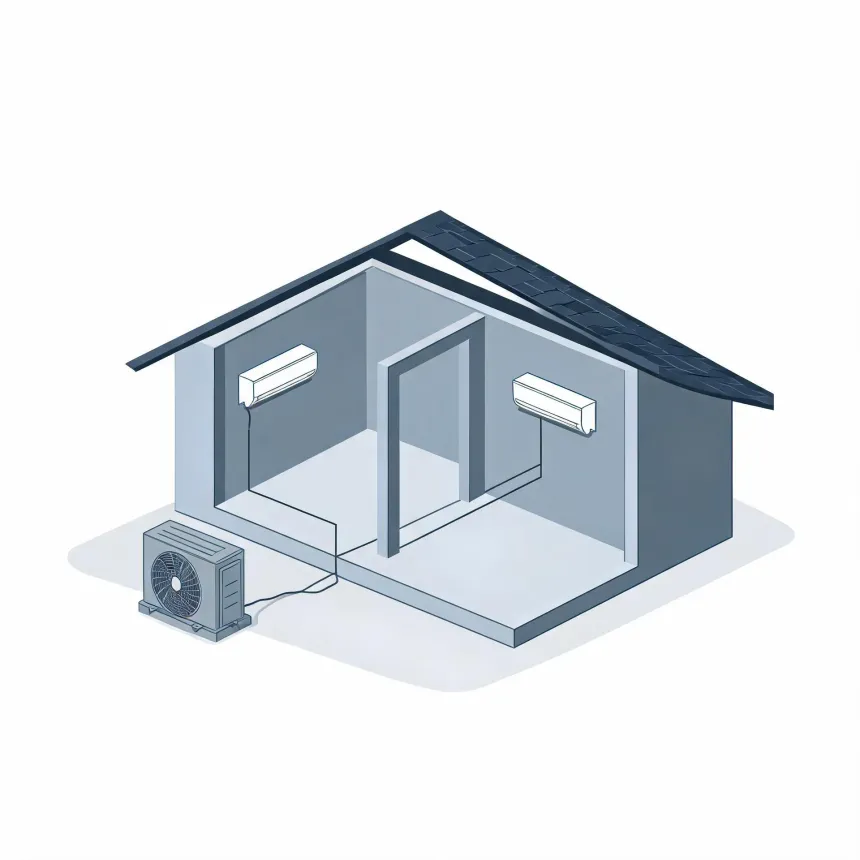
Isometric illustration of a cutaway house showing two wall-mounted indoor air conditioning units connected by lines to a single outdoor condenser unit on the ground outside.
Your system heats October through May and cools June through September.

NOAA nClimDiv, 1991–2020 normals

Cooling here starts in June.

Install before May runs out and the job happens on your schedule, not during the first heat wave.

Half these homes went up before central air did

Half the homes here were built by 1955
Cooling runs June through September
Summer afternoons average 82°F

Nassau County sits in climate zone 4A, which the energy code treats as mixed: real heat to push back on in winter, real humidity to pull out in summer. Any mini-split installed here now has to meet the federal minimum for that kind of system. For a split-system heat pump built from 2023 on, that means pulling at least 14.3 Btu of heat for every watt-hour it uses in summer, and delivering at least 7.5 Btu per watt-hour in winter. That floor narrows what a contractor can offer you. It also sets a baseline the equipment has to clear before anyone talks about which unit to buy.

The rating on the unit decides what every bill after installation looks like

That efficiency rating only pays off if the unit is sized and installed to match this house. Get the install right and you're done thinking about it on every bill that follows.

Find a contractor
A white outdoor air conditioner condenser unit mounted on metal wall brackets against gray horizontal siding, with a blue sky and white clouds behind it.

The house decides where the unit goes

Half the homes in Nassau County were built in 1955 or earlier. That's the house this job has to fit, not a newer one with ducts already run for central air. Ask the contractor to walk the rooms with you before they quote anything, and settle on where the indoor units go and where the line set can run without cutting through more wall than it needs to. A mini-split doesn't need ductwork, which is the main reason it suits a house this old. Get the placement right at the start and you won't be revisiting it once the unit is in.

A unit too big still leaves you uncomfortable

An oversized mini-split cools the room fast, shuts off, and starts again a few minutes later. It never runs long enough to pull the moisture out of the air, so the room feels cold and damp instead of just comfortable. The compressor spends its life cycling on and off, which wears it harder than running steady.

The load calculation is the whole job

A contractor works out the right size by looking at the square footage of each room, how many windows face the sun, how high the ceilings run, and what's on the other side of the walls. Guessing by room size alone, or matching whatever unit was in the last house, gets the number wrong both directions. Get that calculation right and the rest of the install follows from it.

If the old system is window units or a ductless setup being replaced, those get disconnected and hauled off as part of the job. If it's a central system losing its job to the mini-split, the furnace or air handler often stays, since it may still carry part of the heating load or back up a room the new system doesn't reach. The old refrigerant lines get capped or removed, not left to leak. Any line set, drain, or electrical whip no longer in use should come out of the wall rather than sit dead inside it. A contractor can tell you early which parts of the old system have to go and which ones can stay in place doing a smaller job than they used to.

Gas heats 62.4% of homes in Nassau County, more than every other fuel combined. A mini-split doesn't replace that. Most homes keep the furnace for the coldest stretch of winter and let the mini-split carry summer cooling and the shoulder months. That's a different job than an all-electric heat pump install, and it changes what the contractor sizes the unit for. Tell the contractor up front what's heating the house now. It decides how hard the mini-split needs to work and when.