Gas heats most homes here
Utility gas heats 58.6% of occupied homes in Ontario County. Electricity is next at 16.5%, well ahead of oil and propane.
Takes about a minute. No obligation.
Utility gas heats 58.6% of occupied homes in Ontario County. Electricity is next at 16.5%, well ahead of oil and propane.
A mini split installed in a gas-heated home usually isn't replacing the furnace. It's handling the rooms or seasons where running the furnace and central air doesn't make sense, like a single addition or a home that has no ductwork at all.
NOAA nClimDiv, 1991–2020 normals
Geneva only needs cooling for about two months, July and August, with afternoon highs around 79°F.
A mini split here isn't fighting a long summer, so a mid-range unit holds up fine without paying for top-tier efficiency.



Half the homes in Ontario County were built in 1976 or earlier, half after. That split doesn't push a mini split one way or another. A room addition on an old house and one on a new house need the same thing, a unit sized to the square footage and the number of windows in that room. Mini splits come in a handful of standard sizes, and one of them fits almost any room people are using this way. There's no reason in Geneva to size up or pay for a premium line just because of the year a house was built.
Ontario County falls in climate zone 5A, where heating is the bigger job. The federal standard treats a ductless mini split as a split system, so any unit made from 2023 on has to hit at least 14.3 SEER2 for cooling and 7.5 HSPF2 for heating. That sets the floor for what a contractor can install, and a federal tax credit is available on top of it.
Find a contractorTwo months a year this unit cools. The rest of the year it's either heating or sitting idle, and heating is the lighter job on a compressor built for both. With that little work asked of it, a mid-range mini split holds up fine here. What takes one out early is a bad install or years with a dirty filter, not hours on the clock.
A contractor works out the load from the square footage, the window area, the ceiling height and what's on the other side of the walls. Each room gets matched to one of the standard sizes a mini split comes in, not rounded up for safety.
An oversized unit cools the room fast and shuts off before it pulls the moisture out of the air, so the room feels cold and clammy at the same time. An undersized one never catches up on the hottest or coldest days, running flat out without holding the temperature anyone set.
Comparing mini splits means asking about the parts you won't see once it's installed. How many zones is the outdoor unit rated for, and is this one running alone or sharing a compressor with units in other rooms. Sharing cuts cost but means the rooms pull on the same capacity at once. Ask what happens on the coldest nights, since every mini split has a point where it leans on backup heat or just loses ground, and that point varies by model. Ask about the line set length too. Run it too far from the outdoor unit and the system loses efficiency no matter what the rating sticker says. A contractor who answers these without pausing has actually sized the job.
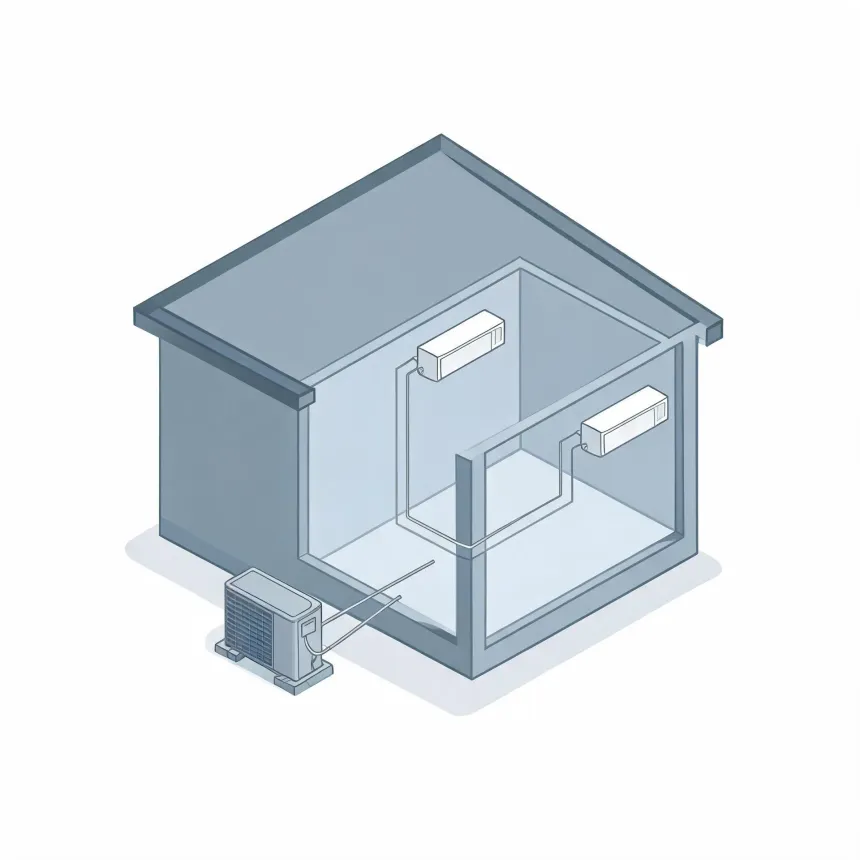
The cost of putting in a mini split comes down to what has to happen before the unit ever turns on. Running the line set and the wiring from outdoor unit to indoor head is most of the labor, and a short, simple path costs less than one that has to cross an attic or come up through a wall with no clear route. Multi-zone systems add cost per zone, since every indoor head needs its own run back to the outdoor unit. The outdoor unit needs a pad or mounting bracket set somewhere it can pull air freely, and a wall or roof that makes that hard adds work. Electrical matters too. If the panel already has room for a new circuit, that's a simple job. If it doesn't, upgrading the panel costs more than the mini split itself in some cases. None of this shows up on a price sheet until someone looks at the actual walls and the actual panel.