Gas heats most homes here
Utility gas heats 69.2% of homes in Chemung County. Furnaces and boilers are the common setup, with ductwork or hot water lines already built around that fuel.
Takes about a minute. No obligation.
Utility gas heats 69.2% of homes in Chemung County. Furnaces and boilers are the common setup, with ductwork or hot water lines already built around that fuel.
A mini split does not replace a gas furnace here, it adds cooling or covers a room the furnace does not reach well. Most of these homes are set up to add one without touching the existing heat.
NOAA nClimDiv, 1991–2020 normals
Cooling only runs about two months here, July and August, with afternoon highs around 79°F.
A mini split in Chemung County isn't working against a long, hot season, so a mid-range unit holds up fine without the top efficiency tier.




July is when cooling starts here, so June is the month to get a mini split installed. That gives the contractor room to schedule the work before the first hot stretch instead of fitting you in during one. Cooling only runs through August here, two months total, so there's no long season to lose part of by waiting. Get it in ahead of July and it's ready the first day you need it.
Chemung County sits in climate zone 5A. Any ductless mini-split installed here has to clear the federal minimum for split-system heat pumps, 14.3 SEER2 for cooling and 7.5 HSPF2 for heating. That's the floor a contractor has to meet, not a target. A federal tax credit is available for qualifying heat pump installations, which can offset part of the cost of getting there.
Find a contractorTwo months a year, the compressor actually has to work. The other ten, it sits off. Over a year that adds up to light use for the equipment, which is part of why a mid-range unit is enough here. Spend the difference on a careful installation, the right line set length and a contractor who sizes the unit to the room instead of guessing high.
A contractor works out the size by checking the square footage of the space, the windows, how the room is insulated, and what else is nearby giving off heat. That math points to a specific capacity for that room. It is not a guess and it is not based on the size of the old equipment, if there was any.
An oversized mini split cools the room fast, then shuts off before it has pulled the moisture out of the air. That leaves the room feeling clammy even at the right temperature, and the compressor spends its life switching on and off instead of running a steady cycle. The right size runs longer, steadier stretches and that is what keeps the air comfortable, not just cold.
If this is going in next to an old window unit or electric baseboard, the contractor handles taking that out as part of the job. A window unit just lifts out. Baseboard heaters involve a wire running back to a breaker, so that gets capped off or removed by someone who can do that safely, not pulled out on its own. Neither one needs to stick around once the mini split is in. If the old equipment still runs, it can usually be passed on or scrapped for the metal rather than thrown out whole.
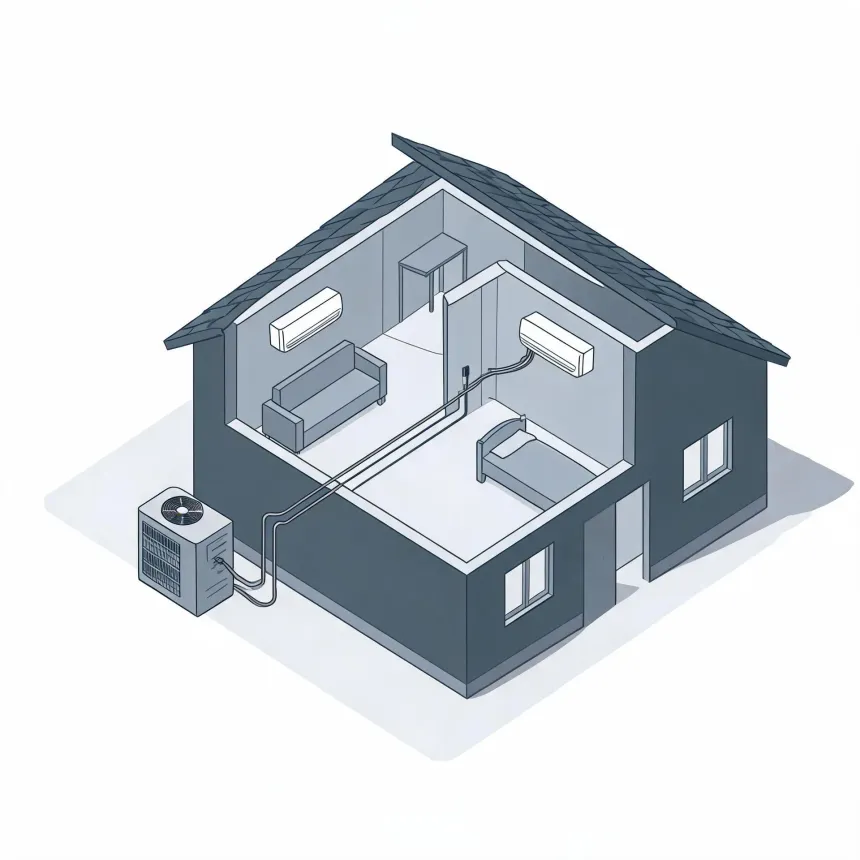
Installation day starts outside with the condenser. The contractor sets it on a pad or a wall bracket, somewhere with room for air to move through it. From there a line set runs to the indoor head. It carries refrigerant lines, a drain line, and the electrical whip that powers the indoor unit. That means a hole through the wall, usually placed right behind where the indoor head will hang so it stays out of sight. Once both ends are connected, the lines get pulled into a vacuum before any refrigerant moves through them. That pulls out the air and moisture that would otherwise corrode the line from the inside. After that the system gets charged and run, and the contractor checks the temperature split between the air going into the indoor unit and the air coming back out.