Most homes here run on gas
Utility gas heats 54.6% of homes in Steuben County, more than any other fuel. Electricity is next at 14.7%, with propane close behind at 14.3%.

Takes about a minute. No obligation.
Utility gas heats 54.6% of homes in Steuben County, more than any other fuel. Electricity is next at 14.7%, with propane close behind at 14.3%.
In a gas-heated house, a mini split usually goes in for cooling or for a room the furnace doesn't reach well. The gas system keeps handling the main heating load.
NOAA nClimDiv, 1991–2020 normals
Electricity in New York runs 24.43 cents per kilowatt-hour.
A correctly sized mini split keeps that cost down. There's no need to oversize it here.




Steuben County sees its share of severe weather, 198 events over the last ten years, most of it damaging wind. That matters more for the outdoor unit's mounting than for sizing the system itself. A mini split's compressor sits outside on a pad or wall bracket, and a contractor will set it where wind-driven rain and ice runoff from the roof won't reach it. None of this changes what size unit the room needs. A standard mini split sized to the space will heat and cool it the same way whether the county sees calm weather or 179 wind events. Pick the unit for the room, not for the storms.
Steuben County falls under climate zone 5A, where heating is the bigger job for any system. A mini split installed here has to meet 14.3 SEER2 for cooling and 7.5 HSPF2 for heating, the federal minimum for split-system heat pumps. That rules out the lower-efficiency units still sold in warmer parts of the country. A federal tax credit is available toward the cost of a qualifying system.
Find a contractorCooling runs about two months here, July and August, with afternoon highs averaging 78. That's a short, mild season to ask a compressor to work through. Heating is the bigger job in this zone, and a mini split's heat pump side will run far more hours than its cooling side ever will. A unit sized right for the room handles both without strain. Years from now, what fails on a system like this is usually a part that's aged or a filter that never got cleaned, not a compressor worn out from a tough summer.
Every heat pump has a point where it stops pulling heat from outside air and leans on backup resistance heat instead. That point varies a lot between models. Ask the contractor what temperature this unit is rated to and what happens below it. A system that gives up early means more electric heat strip use, which costs more to run.
Sizing should come from a load calculation on the actual room, its windows, its exposure, its ceiling height, not a rule of thumb based on square footage alone. A unit that's too big will cool the room fast and shut off before it pulls the moisture out of the air, leaving it cold and damp. Ask to see the numbers, not just a recommendation.
If the mini split is going in alongside the furnace, the old system isn't going anywhere, so there's nothing to decommission there. Where it gets replaced is when the new unit is taking over a job an old electric baseboard or window AC used to do. A window unit comes out of the frame and the opening gets sealed back up properly, not just stuffed with foam. Baseboard heaters get disconnected by someone who can confirm the circuit is dead before touching the wiring. If what's coming out is a wall furnace or anything with a gas or propane line feeding it, that line has to be capped by someone licensed to do it, not left behind for later. None of this touches the furnace itself. That stays right where it is, doing what it already does.
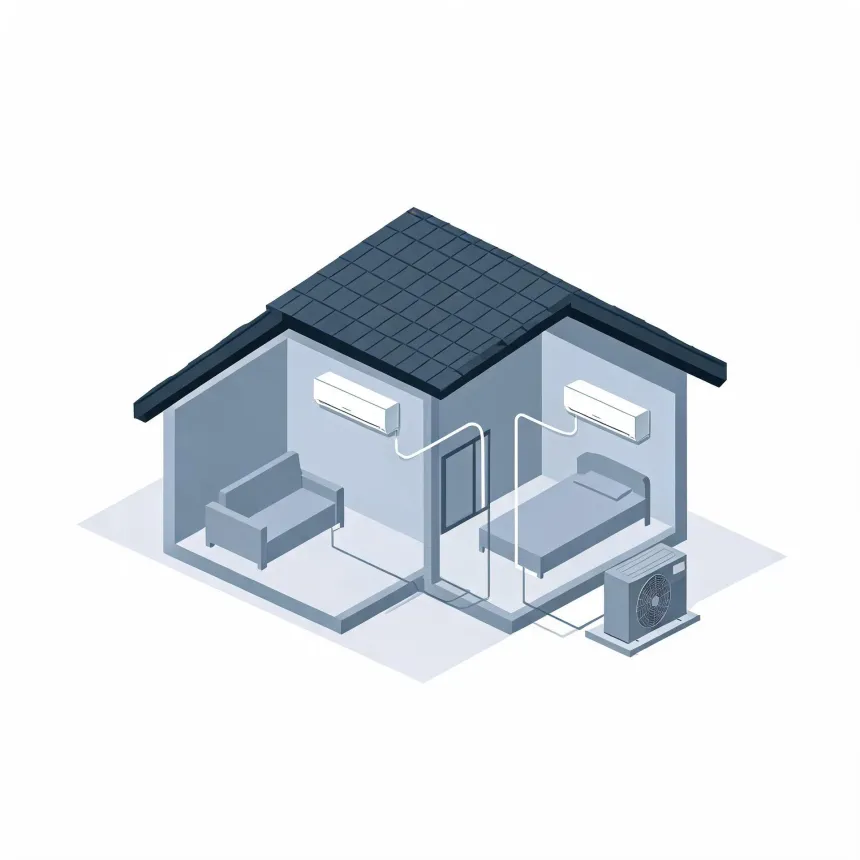
Installation day starts with the outdoor unit and the indoor head going up, not the refrigerant lines. The outdoor unit gets mounted first, then the indoor head on the wall or ceiling where it was measured for. Once both are in place, the contractor runs the line set between them, the copper tubing that carries refrigerant, along with a drain line and the electrical whip. These get routed through a single small hole in the wall, not cut into existing ductwork, since a mini split doesn't use any. After the lines are connected at both ends, the system gets evacuated with a vacuum pump to pull out air and moisture before the refrigerant is released into the lines. Moisture left behind in the lines can damage the compressor down the road, so that step doesn't get skipped. Once it holds vacuum, the contractor checks refrigerant charge, confirms the indoor head is level and draining properly, and runs the system through a cooling and heating cycle before calling it done.