Gas heats almost every home here
86.8% of homes in Erie County heat with utility gas. A furnace or boiler is already doing the heavy lifting most winters.
Takes about a minute. No obligation.
86.8% of homes in Erie County heat with utility gas. A furnace or boiler is already doing the heavy lifting most winters.
Most mini split jobs here go in alongside the gas system, for a room that runs hot or cold on its own, or for cooling where there's no ductwork to carry it.
NOAA nClimDiv, 1991–2020 normals
Electricity in New York runs 24.43 cents per kilowatt-hour, well above the national average.
A mini split sized right for the room it serves keeps that cost down better than one that's too big for the job.



Half the houses in Erie County were built in 1957 or earlier. A mini split going into one of these has to work with what's already there, not what a newer house would have. Older homes usually got their gas or steam heat room by room, so there may not be a good spot for a line set to run without notice. Plaster walls and balloon framing change how a contractor runs the refrigerant line and where the outdoor unit can sit. None of that rules out a mini split. It just means the install plan has to start with the house you actually have, not a standard layout.
Cooling here runs July through August. Get a mini split in during June and it's ready the first hot week, installed on your schedule instead of while the room sits hot waiting on a crew or a part.
Find a contractor
Cooling runs two months here, July through August, with afternoon highs averaging 78°F. That's not much time for a compressor to put in work. A mini split sized for the room it serves won't be pushed hard over a season that short. That means a basic reliable unit holds up as well as a high-end one. Better to put the money into getting the install right for the room.
If the mini split is replacing an old window unit or a wall sleeve, that unit comes out and the opening gets sealed or patched. If it's going in alongside the gas furnace or boiler, nothing about that system changes. A mini split doesn't connect to ductwork or a gas line, so there's no old equipment to remove or disconnect for the rest of the heating system to keep working.
A window unit left in place after a mini split goes in in the same room is just a draft point and a worse air seal, not a backup. If the room had no cooling before, there's nothing to remove, only the new line set and outdoor unit to add. Either way the old equipment doesn't factor into how the new system gets sized or installed.
A few questions get past the brochure numbers. Ask whether the system is single-zone or multi-zone, and if it's multi-zone, how many indoor heads the outdoor unit can actually run at once without each one losing capacity. Ask what happens if one indoor head needs service down the road, whether the rest keep running or the whole system shuts down with it. Ask about the line set, how far it has to run and how many bends it needs to reach a spot where the outdoor unit can sit. A longer run with more turns costs some efficiency no matter whose name is on the unit. None of this is about chasing the highest-end model. It's about making sure the one going in is matched to the room and the spot it has to sit in.
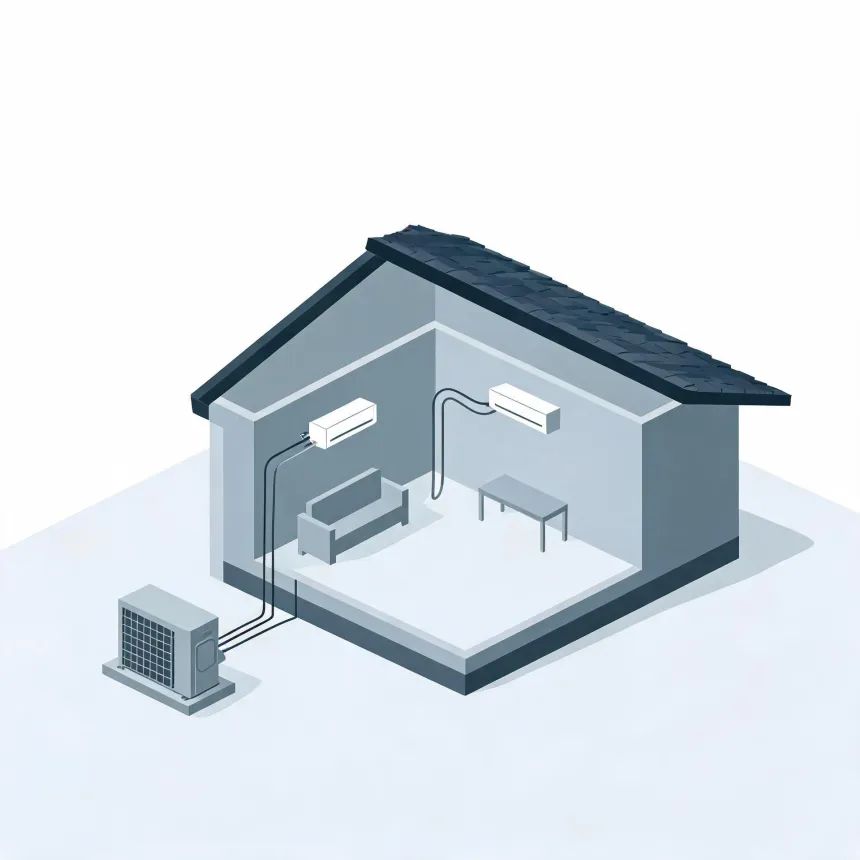
Installation starts with where the lines run, not where the indoor head looks best. A contractor sets the outdoor unit first, on a pad or wall bracket with clear space around it for airflow, then runs the line set to each indoor head through a hole drilled in the wall. That line set carries refrigerant, a drain for condensation, and the wiring, all bundled and sealed where it passes through. Once the indoor head is mounted and connected, the system gets evacuated with a vacuum pump to pull out air and moisture before the refrigerant ever moves through it. Skip that step and the system can develop problems that show up months later, not on day one. The last part is charging the line and testing each zone, heat and cool, before anyone calls the job done.