Electricity here runs 36.97 cents a kilowatt-hour
That's higher than what most US counties pay. A mini-split runs on electricity alone, so every hour it works shows up on the bill at that rate.

Takes about a minute. No obligation.
That's higher than what most US counties pay. A mini-split runs on electricity alone, so every hour it works shows up on the bill at that rate.
At a rate this high, the difference between a unit that runs well and one that doesn't gets magnified. How the mini-split is sized and installed in your home matters more here than it would somewhere with cheaper power.
NOAA nClimDiv, 1991–2020 normals
Cooling here runs June through September.
Get a mini-split installed before June and the first hot week isn't a scramble to find someone.




Bronx County falls under zone 4A in the 2021 energy code, a mixed climate that asks real work of a system in both directions. A mini-split installed here has to meet the federal minimum for that split-system class, units made from January 2023 onward have to pull at least 14.3 Btu of cooling from every watt-hour of power, and deliver at least 7.5 Btu of heat per watt-hour over the winter. That's not a target a contractor aims for. It's the floor every new unit sold has to clear before it goes in. A system that just meets it will run differently than one built well past it, and at Bronx power rates that difference carries through to the bill every month it runs.
You can't change what power costs here. You can change how much of it a mismatched or poorly installed system wastes. Get the sizing and the install right from the start and that efficiency rating actually holds up on your bill.
Find a contractor
A house built in 1955 or earlier was built without a mini-split in mind, since the equipment didn't exist yet. That matters for where the indoor unit can go and how far the line set has to run to reach the outdoor unit. A contractor sizing the system needs the actual room, not a guess based on the house's age or its square footage. Get that sizing right and the unit holds its efficiency rating for as long as it runs here.
A mini-split sized off a room by room heat loss and heat gain calculation runs efficiently for as long as you own it. One sized by rule of thumb either short cycles because it's too big for the space or runs flat out and never quite catches up because it's too small. Both cost more to fix after the fact than the calculation costs up front.
How far the indoor head sits from the outdoor condenser, how many bends the line set needs, and whether it runs through an exterior wall, a chase, or along the surface all change how long the install takes and what it takes to do it well. A straight run through one wall is a different job than one that has to snake up through a soffit or across a roofline, and the harder path costs more in time and material regardless of the equipment itself.
Sizing a mini-split means working out how much heat a room gains in summer and loses in winter, then matching that to a unit that can cover it without strain. That calculation looks at the walls, the windows, the ceiling height, what's on the other side of each wall. A contractor who skips this and sizes off square footage alone is guessing. Too big and the unit cools the room fast, shuts off, and starts again before it's pulled any moisture out of the air, so the space feels cold and damp at once. Too small and it runs constantly without ever reaching the temperature you set it to. Either way the compressor cycles in a way it wasn't built to, and that shortens its life.
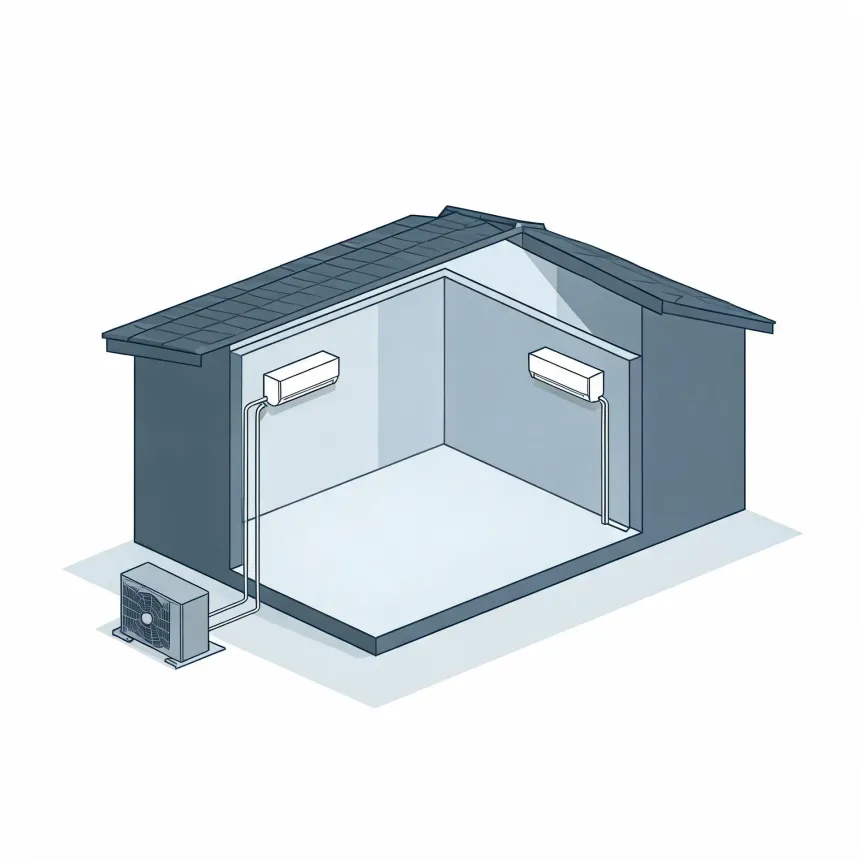
Installation starts with the outdoor unit and the indoor head going up before anything gets connected. The outdoor unit needs a pad or mounting brackets set level, with clear space around it for airflow. Inside, the mounting plate goes on the wall first, and the indoor head hangs off it once the lines are run. A hole gets drilled through the wall for the line set, the refrigerant lines, the power cable, and the condensate drain, all bundled together and routed from the indoor unit to the outdoor one. Once everything's connected, the lines get pressure tested and then pulled down to a vacuum to clear out any air and moisture before the refrigerant is released into the system. That vacuum test matters more than people think. Any moisture left in the lines mixes with the refrigerant and can damage the compressor over time. Last comes the startup, where the contractor checks refrigerant pressures, confirms the thermostat and remote are talking to the unit, and walks the system through a full heating and cooling cycle before calling it done.