
Most homes here heat with gas
Utility gas heats 59.4% of homes in Broome County, more than any other fuel. Electricity is next at 18.4%, with fuel oil and propane making up most of the rest.
Takes about a minute. No obligation.
Utility gas heats 59.4% of homes in Broome County, more than any other fuel. Electricity is next at 18.4%, with fuel oil and propane making up most of the rest.
If your home has a gas furnace, a mini split usually goes in as a way to cool specific rooms or to heat and cool a space the furnace doesn't reach well, like an addition or a finished attic. It doesn't have to replace what's already there.
NOAA nClimDiv, 1991–2020 normals
New York homes paid 24.43 cents per kilowatt-hour in 2024.
A mini split that's sized right for the room keeps that cost down better than one that's too big or too small.




Broome County recorded 314 severe weather events between 2015 and 2024, mostly damaging wind, along with hail, a handful of tornadoes, and winter storms with heavy snow and ice. None of that changes what a mini split needs to be here. Wind and ice can knock out power, and when they do, a heat pump sits off like any electric system does until power comes back on. That's true of this equipment everywhere, not something particular to Binghamton. A standard mini split sized to the room handles what this climate asks of it. There's no case here for oversizing the unit or paying more for a higher tier to stand up to the weather.
Cooling in Broome County runs from July through August. June is the month before it starts, and that makes it the month to get a mini split installed. Pick the equipment and schedule the work before the heat shows up, and installation happens when it suits you instead of when the first hot week forces the issue.
Find a contractorTwo months of real work a year is a light enough load that you don't need to chase the highest-efficiency mini split on the lot. Put the money into a unit sized right for the room and a contractor who sets the charge correctly. A reliable mid-range system run well will outlast a top-tier one installed poorly, and here, where the compressor isn't working hard most months anyway, that's the part worth paying for.
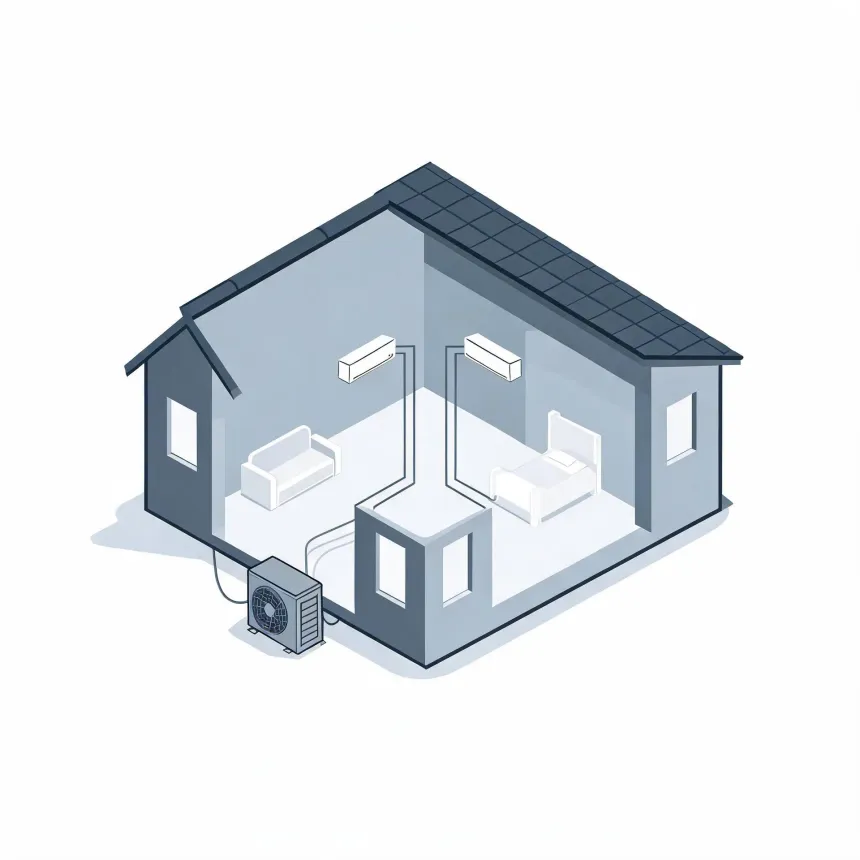
A single room needs one indoor head and one outdoor compressor matched to it. Add a second or third room and you're either running separate single-zone systems or one multi-zone compressor with a head in each space. A multi-zone unit costs more up front but means one outdoor unit instead of several, and the lines running between indoor and outdoor units are part of what gets sized and charged with refrigerant, not an afterthought.
The refrigerant lines and wiring have to get from the outdoor compressor to each indoor head, and that path matters more than the equipment does. A head going on an exterior wall near where the compressor sits is a short, simple run. A head on the far side of the house, through finished walls or up multiple floors, means more line set, more wall penetrations, and more time on the ladder. The contractor doing the walkthrough is pricing that path, not just the units.
When you're comparing quotes, ask each contractor to walk you through their load calculation, not just hand you a number. It should account for the room's square footage, ceiling height, window area, and insulation, not a flat rule of thumb. Ask what size head they're proposing and why, since an oversized unit cycles on and off instead of running steady, and that short-cycling is hard on the compressor and leaves the room feeling clammy even while it cools. Ask where the outdoor compressor will sit and how the line set gets from there to the indoor head. Ask what happens to the warranty if something other than the installing contractor services it later. And ask who sets the refrigerant charge and how they verify it, since a charge that's off by even a little will cost you efficiency for the life of the system.
Installation day starts with the outdoor compressor and the indoor head going up, not the power turned on. The installer mounts the indoor unit, sets the outdoor compressor on its pad or bracket, and runs the line set between them through a wall penetration, usually one small hole rather than anything major. Once both units are in place and connected, the system gets evacuated with a vacuum pump to pull out air and moisture before any refrigerant goes in. That step matters as much as anything else done that day. Only after the lines hold a vacuum does the installer charge the system and check that it's drawing the right amount. The last part is running the system through both heating and cooling to confirm the head responds and the compressor cycles the way it should before anyone calls the job done.