






White colonial houses with lit windows photographed at dusk along a tree-lined residential street.

Mini Split Installation in Auburn, NY

Tell us about the job

Takes about a minute. No obligation.

New system or replacementMini-splitCayuga County, NY
Step 1 of 2

What ZIP code is the job in?

Utility gas heats almost half the homes in Cayuga County, and most of the rest split between electric, propane and oil. A mini split doesn't replace a furnace tied into that system. It takes over the jobs a furnace is bad at. A bonus room that never gets warm. A garage someone finished. A sunroom that bakes in summer. In homes without ductwork reaching a space, it's often the only option that doesn't mean tearing open walls. Paired with a gas or oil furnace, it also gives you a way to cool the house without adding central air.

8 months
October through May, your system heats
2 months
July through August, it cools
19°F
the average winter night it heats against
78°F
the average summer afternoon it cools against
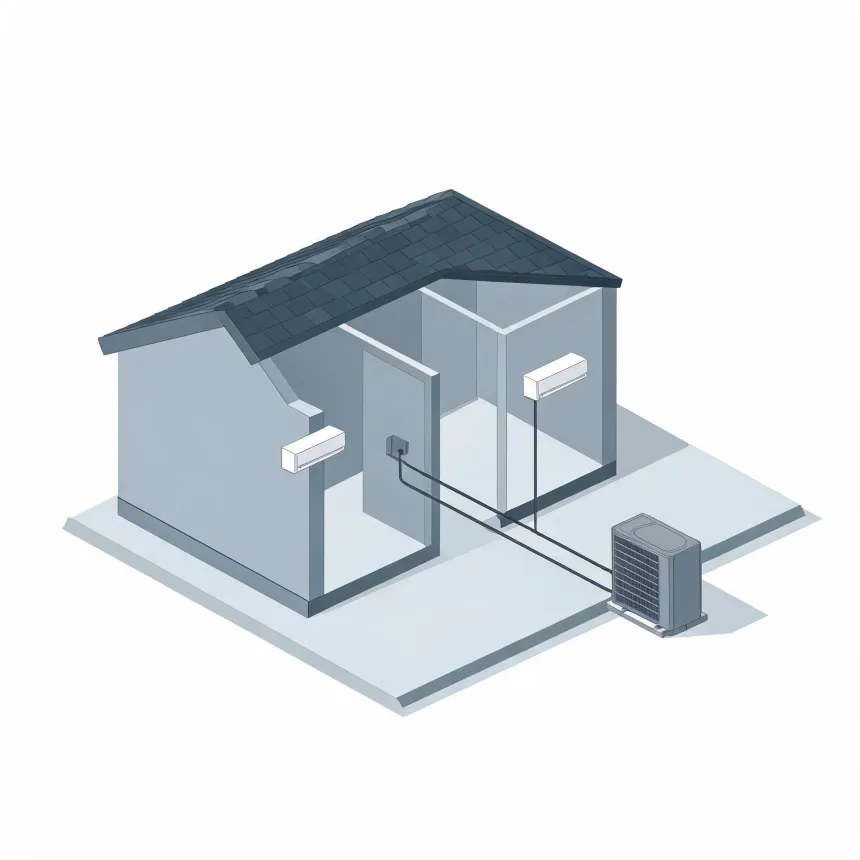
Isometric illustration of a cutaway gray house with a dark shingled roof, showing two wall-mounted indoor air handlers connected by line sets to an outdoor condenser unit on a pad outside.
Your system heats October through May and cools July through August.

NOAA nClimDiv, 1991–2020 normals

Every quote should list how many zones and what size each indoor head is.

A unit sized wrong for its room runs constantly or shuts off before the room feels right.

Half the homes in Auburn were built in 1958 or earlier, and a mini split has to work with the walls it finds

Half the homes here were built by 1958
Cooling runs July through August
Summer afternoons average 78°F
Cooling starts in July hereCooling runs July and August here. Install before June ends and it's ready when the heat is.

A mini split sized to the room earns its keep here without going bigger or pricier than it needs to be. Electricity runs 24.43 cents per kilowatt-hour in New York, among the higher rates in the country, and a unit too large for the space just cycles on and off instead of running steady. The right size comes from the room itself. Square footage, window count, whether it sits over a garage or under a roof all factor in. Nothing about Auburn's climate pushes that number up. A contractor should size each head to its room, not round up out of habit.

Pick reliable, not top of the line

It won't be worked hard here, so pick a reliable system that fits. You don't need the top efficiency model.

Find a contractor
A man in a dark shirt and tan pants carries a canvas tool bag up stone steps toward a dark blue front door, with a potted shrub beside the entry.
A white mini-split air conditioner outdoor condenser unit mounted on metal brackets against a beige stucco exterior wall, with a blue sky and scattered clouds in the background.

The install has to work around the house, not the other way around

An installer working on a house from this era has to run line sets and wiring to whatever wall or soffit actually gives access, not wherever the plan would put them in a newer build. That's a question to walk through room by room before install day, not something to settle from a quote alone.

The number of zones sets the floor

Every indoor head needs its own line set, its own run of wiring, and its own share of the outdoor unit's capacity. A system feeding several rooms costs more to put in than a single zone, because there's more line hidden in the walls and the outdoor unit has to carry a bigger load. Adding a zone later costs more than planning for it up front, since the outdoor unit and the wall penetrations are sized to what's installed that day.

Where the lines have to run moves the labor

A straight shot from the indoor head to an exterior wall near the outdoor unit is the cheapest line set to install. Every bend, every floor the line has to drop through, every stretch of soffit or chase it needs covered adds time on site. The outdoor unit's placement matters too. If it has to sit far from the heads it serves, or somewhere that needs a stand or extra mounting, that's more material and more hours before the system ever runs.

If this is adding a mini split alongside an existing furnace, that system doesn't go anywhere. It keeps heating the rest of the house, and the mini split just takes the rooms it was never good at. If this is replacing something that already serves the space, whoever installs the new unit should also deal with what's left behind. An old window unit can just get pulled. A ducted system being partly abandoned needs those ducts sealed off properly, not just capped with tape, or conditioned air leaks into a space nobody's using. Ask what happens to the old equipment before install day, not after.

Install day starts outside. The outdoor unit gets mounted on a pad or brackets, then the crew runs the line set, a bundle carrying refrigerant lines, a power cable and a condensate drain, from that unit to each indoor head. That line set needs a hole through the wall, usually small enough to patch in an afternoon. Inside, the wall bracket goes up first, then the indoor head hangs on it, gets connected, and the whole system gets charged with refrigerant and tested. A tech checks line pressures, confirms the head is pulling and pushing air the way it should, and walks the room to make sure nothing is rattling or leaking before calling it done. Most of the day is that line set and the connections, not the units themselves.