Gas heats most homes here
Utility gas heats 64.5% of occupied homes in Albany County. Furnaces and boilers tied to a gas line are the default, with electricity, propane, and oil covering the rest.

Takes about a minute. No obligation.
Utility gas heats 64.5% of occupied homes in Albany County. Furnaces and boilers tied to a gas line are the default, with electricity, propane, and oil covering the rest.
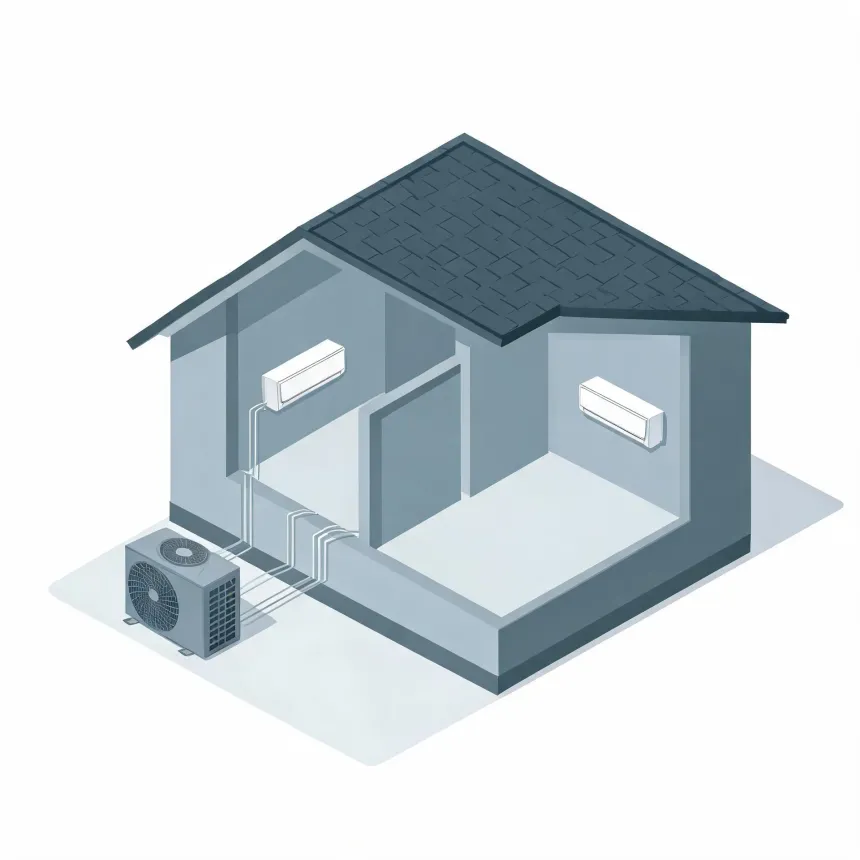
A mini split does not need to replace what is already heating the house. It can cover a room the main system struggles with, or take over cooling without touching the gas furnace at all.
NOAA nClimDiv, 1991–2020 normals
The old system does not have to come out for a mini split to go in.
Taking out an old wall unit or window AC is a quick pull, but a furnace or boiler tied into ductwork stays put and the mini split just adds to it.




Cooling in Albany County runs July through August. June is the month to get a mini split installed, not July. Installation means mounting the outdoor unit, running the line set through the wall, and setting the indoor head, and that work goes easier without a heat wave pushing the schedule. Get it done in June and the system is already running when the first hot week hits. Wait until July and you're asking for the same install while trying to cool a house that already needs it.
Albany County falls in climate zone 5A, a cool zone where winter heating is the bigger job. Any mini split installed here has to be a split system that clears 14.3 SEER2 for cooling and 7.5 HSPF2 for heating, the federal minimum for units built from 2023 on. That standard also makes some installations eligible for a federal tax credit. A contractor can confirm which equipment qualifies.
Find a contractorTwo months of work a year is not much to ask of a compressor. That short a season means the outdoor unit spends most of the year off, and the parts that wear, the compressor and the fan motor, rack up fewer hours doing it. You do not need the highest SEER2 unit on the lot to get through an Albany summer. A reliable mid-range system, sized right for the room, will clear the two months in July and August without strain. Put the money into a good install instead, since that decides more about how this system runs than the efficiency number on the spec sheet.
If a mini split is replacing an older system, find out whether the new install reuses existing line sets or runs new ones. Old line sets are sized and rated for old refrigerant, and reusing them with new equipment can mean a system that never holds the correct charge no matter how carefully it gets filled.
The indoor head pulls moisture out of the air, and that water has to go somewhere. Ask each contractor where the drain line runs and how it leaves the house. A drain line with nowhere good to go gets routed somewhere awkward after the install, instead of planned for before it.
What drives the cost of a mini split install is mostly hidden from the spec sheet. The line set run matters more than the equipment grade. A short, clean path from outdoor unit to indoor head takes less refrigerant line, less wall penetration work, and less time on the lift. Run that same line through framing or up past another floor to reach the room that needs it, and the labor climbs even though the equipment is identical. A multi-zone system adds its own cost layer, since each indoor head needs its own line set and its own spot on the outdoor unit's circuit board. Electrical work is the other piece. A dedicated circuit sized for the outdoor unit is part of a proper install, and whether that means a simple tie-in or a panel upgrade depends on what the panel already has room for.
Install day starts outside. The outdoor unit gets mounted on a pad or brackets, leveled, and set where it has clearance on all sides to pull and push air. Inside, the crew marks where the line set and wiring pass through the wall, drills a single hole, and sets the indoor head on its mounting plate. The refrigerant lines, power wire, and condensate drain all run through that one penetration, then get sealed against the weather. Once the indoor and outdoor units are connected, the line gets evacuated with a vacuum pump to pull out air and moisture before refrigerant is released into it. That vacuum step matters more than people expect. Any moisture left in the line turns into acid over time and eats at the compressor from the inside. Last comes the test run, checking the temperature split between the air going in and the air coming out, and confirming the head responds to the thermostat the way it should.